The High Priestess doesn’t arrive when you’re confused.
It arrives when you already know – and aren’t quite letting yourself.
There’s a specific kind of moment this card describes. Not uncertainty, exactly. Something more precise than that. The moment when you’ve registered something – about a person, a situation, a direction – but the knowing hasn’t yet taken a shape you can put into words. It sits below the surface, clear enough to be felt, not yet formed enough to be defended.
And so you wait for proof. You look for something external that will confirm what you already sense. You tell yourself you’re being careful, or fair, or rational. You talk yourself into a different interpretation that requires less trust in your own perception.
The High Priestess is not about trusting the universe. It is not about feminine wisdom or mystical intuition in the vague sense those words usually carry. It is about the specific, demanding experience of knowing something before you can explain it – and what happens when you don’t trust that knowing enough to let it guide you.
The High Priestess tarot meaning is about the gap between sensing and understanding. And it’s considerably smaller than most people treat it.
Quick Answer
The High Priestess tarot meaning centers on inner knowing, perception before proof, and the awareness that exists before it can be fully articulated. This is the card of what you sense before you can explain it – of information that arrives not through analysis but through attention.
The High Priestess tarot card represents the capacity to perceive what is not yet visible, to read what is not being said, and to hold that perception with enough steadiness that it doesn’t need immediate external confirmation to be real.
The High Priestess is not the card of passivity. It is the card of a specific kind of intelligence – the kind that operates before the words arrive.
Key Takeaways
- The High Priestess tarot meaning centers on inner knowing – perception that exists before proof and understanding that precedes explanation.
- This is not a passive card. It is the card of a specific, demanding form of attention.
- The High Priestess knows something. The question is whether you trust what you know.
- Upright: something is being perceived that hasn’t yet fully surfaced – the right move is to observe, not to force clarity. Reversed: ignoring what you sense, or confusing fear with intuition.
- The discomfort of this card is not uncertainty. It is the specific discomfort of knowing something you haven’t yet allowed yourself to act on.
- Not everything needs to be explained before it’s real. Some things are real before they can be explained.
- The High Priestess doesn’t ask you to act. It asks you to pay attention – which is harder than it sounds.
What Does The High Priestess Tarot Card Mean?
The High Priestess tarot card means something is already known – and not yet being trusted.
This card appears when perception is ahead of understanding. When something about a situation, a relationship, or a decision has already registered – not as a conclusion the mind has reached, but as something the whole of you has noticed, before the analytical part has caught up. The High Priestess points to that lag: the gap between what you sense and what you allow yourself to know.
It is the card of the person who is receiving real information and explaining it away.
Core Meaning
The High Priestess tarot card represents the state of internal awareness that exists before verbalization – before the knowing has been shaped into something explainable, defensible, or shareable.
She is numbered two in the major arcana – after The Magician, who acts with full intentionality, and before The Empress, who creates with full embodiment. Between action and creation, there is perception. The High Priestess holds that space. Not passively. With a particular kind of active, patient attention that is considerably harder than it appears.
What she describes is not waiting. It is the specific discipline of not forcing – of allowing something to become clear in its own time rather than demanding it arrive on schedule. This discipline is difficult precisely because it looks, from the outside, like nothing. It looks like stillness. It is actually work.
Not everything is knowable yet. Some things are still forming. Some situations are revealing themselves gradually, and the reading you make of them today will be wrong by next week. The High Priestess holds that reality – and asks you to hold it too, without collapsing it prematurely into something manageable.
→ The High Priestess is the card of the person who already knows – and is being asked to trust it.
Deeper Meaning
Here’s what rarely gets said about The High Priestess: the thing it’s pointing to is not a lack of information.
Most people, when they feel uncertain, assume they need more data. Another conversation. A clearer sign. More time. More external confirmation. And sometimes that’s true. But more often – and this is where The High Priestess gets genuinely uncomfortable – the information is already there. It has already arrived. It has been registered and processed and understood at a level below the one that generates the explanations.
The problem isn’t that you don’t know.
The problem is that you don’t trust what you know.
The High Priestess sits between what you’ve sensed and what you’ve allowed yourself to believe.
This distinction matters because it changes what the situation actually requires. If the issue is missing information, the solution is to gather more. If the issue is distrust of existing perception, gathering more information doesn’t help – it just generates more material to explain away. The person who doesn’t trust their own reading of a situation will not be helped by additional evidence. They will find a way to work around it.
There’s also a more difficult version of this territory: the confusion between intuition and anxiety. Both arrive without evidence. Both feel urgent. Both can present themselves as knowing. The difference is that intuition tends to be specific and quiet – a clear sense about something in particular, which doesn’t intensify when you stop thinking about it. Anxiety tends to be general and loud – a feeling of wrongness that spreads, that generates scenarios, that gets worse when fed.
Intuition doesn’t need you to act on it urgently. Anxiety does.
This distinction is worth holding carefully because they are genuinely difficult to separate in the moment. The High Priestess doesn’t always make it easy. What she asks is that you develop enough relationship with your own inner processes to know which one is speaking – and enough confidence in your perception to give it weight without immediately needing to prove it to anyone else.
There’s a third dimension this card touches: the social pressure to explain. Most people live in contexts where knowledge needs to be justified. Where saying “I know” without being able to say “because” is treated as insufficient. Where perception without evidence is called bias, or projection, or irrationality. Over time, this creates people who have learned to override their own sensing because it doesn’t come with its own documentation.
The High Priestess is asking what you’ve learned to dismiss because you couldn’t prove it – and whether it was actually wrong.
Symbolism
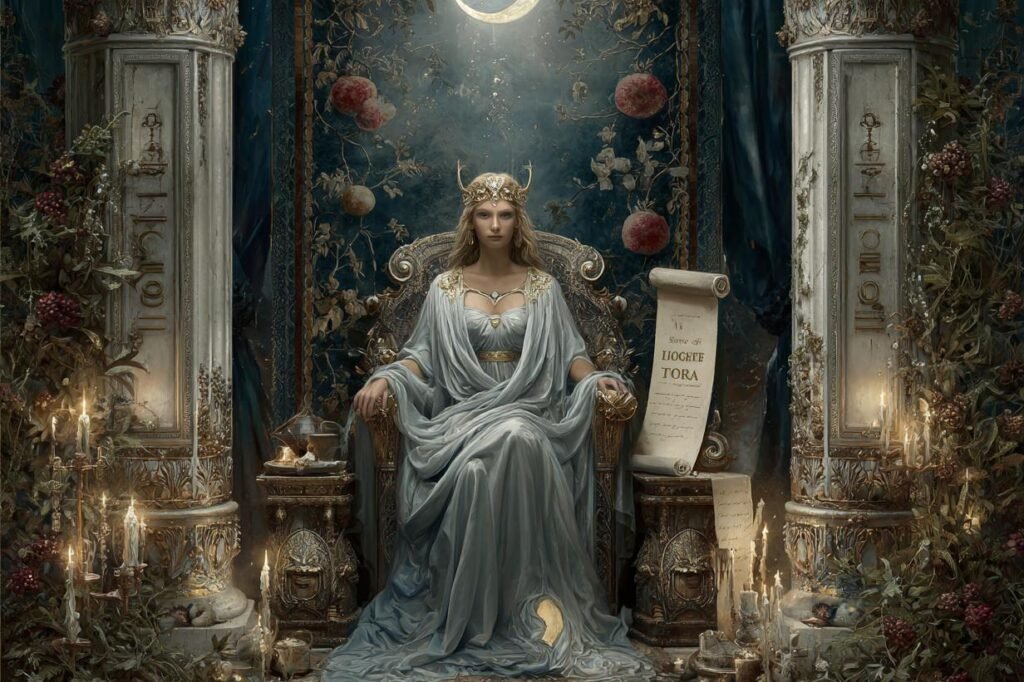
The Rider-Waite image of The High Priestess is precise and still – and every element of it is doing specific psychological work.
She sits between two pillars marked B and J- Boaz and Jachin, from the entrance of Solomon’s Temple. One is black, one is white. Opposite forces. The space between them is where The High Priestess sits: not resolving the opposition, not choosing a side, but remaining in the tension of both. This is the card’s first instruction: not everything that appears contradictory needs to be resolved. Some things are genuinely dual, and the ability to hold that without forcing a conclusion is its own form of intelligence.
Behind her, a veil hangs between the pillars – decorated with pomegranates, half-hidden, accessible only to those who pass through. The veil is not a wall. It is a threshold. What’s behind it is not unavailable – it is not yet visible to someone who hasn’t yet earned the perception. The High Priestess sits in front of it, which means she is at the boundary between what is shown and what is concealed. This is her permanent position. Not fully in either world. In the point of contact between them.
In her lap, a partially unrolled scroll marked TORA – knowledge, law, the accumulated understanding of things. It is not fully visible. It is not meant to be. The scroll represents knowledge that is available but not yet fully revealed – not because it’s being hidden, but because full revelation requires readiness. Some understanding has to be earned through the lived experience that makes it meaningful.
At her feet, the crescent moon: the subconscious, the cycles beneath the surface, the light that is borrowed and reflected rather than generated directly. Unlike The Moon card – which deals with distortion and confusion – the crescent here is composed. It is controlled reflection, not wild illumination.
The water behind her, visible through the veil, is emotional depth – vast, present, and not fully visible from where you stand. The High Priestess is not in the water. She is aware of it.
That awareness – composed, patient, exact – is the card.
Upright Meaning
When The High Priestess appears upright, something is being perceived – and the right response is to observe rather than act on it immediately.
This is not a card of paralysis. It is a card of timing. The High Priestess upright says: what you’re sensing is real, but it hasn’t fully formed yet. The situation is still revealing itself. The action that would serve you is not yet visible – not because you’re incapable of finding it, but because it genuinely isn’t ready to be found.
What this card describes in upright position is the specific quality of attention that allows things to surface at their own pace. The ability to notice without immediately interpreting. To observe a dynamic without immediately needing to resolve it. To sense something about a person or situation without rushing to a conclusion that locks in a reading before the full picture is available.
Common real-life appearances:
- Sensing that something about a relationship has shifted – without being able to name exactly what, or being certain enough to act on it
- Observing a situation at work where something is clearly happening beneath the stated version – and knowing better than to confront it before you understand it more fully
- Making a decision slowly, because something about the faster version feels wrong in a way you can’t immediately explain
- Noticing what someone is not saying and giving that absence the same weight as what is said
- A period of deliberate stillness before a significant move – not from avoidance, but from genuine attention to what is still forming
- The specific experience of being right about something you couldn’t prove – and recognizing that as meaningful data about the quality of your perception
→ Upright, The High Priestess means the information is already arriving – and the work is to receive it without distorting it by acting too soon.
Reversed Meaning
The High Priestess reversed does not simply mean less of the card’s energy. It means a specific break in the relationship between perception and trust.
The most common version is the dismissal of what you’ve sensed. The moment you’ve noticed something – about a person’s tone, about a situation’s undercurrent, about the direction a thing is heading – and then immediately explained it away. Told yourself you were being paranoid. Or oversensitive. Or reading too much into it. And then found out, later, that you weren’t.
The High Priestess reversed meaning in this direction includes:
- Ignoring a persistent sense that something is off, because no single piece of evidence feels conclusive enough to justify trusting it
- Overriding perception with rationalization – generating reasons why what you sense probably isn’t true
- Seeking external validation for something your own perception has already resolved, not because you need the information but because you don’t trust yourself to hold it alone
- Acting – or not acting – in a way that contradicts what you actually sense, and paying the cost of that later
The second direction is the distortion of perception: confusing fear with intuition, or projection with reading. This is where the reversed card becomes genuinely complex.
This version shows up as:
- A persistent sense that something is wrong in a relationship or situation that is actually primarily fear – past experience being applied where it doesn’t belong
- Reading meaning into signals that don’t carry it – interpreting neutral behavior through a lens that confirms an existing anxiety
- Paranoia that presents as sensitivity: a heightened state of alertness that isn’t picking up real signals but generating the appearance of them
- Emotional confusion that makes real perception impossible – too much noise to read clearly
→ Reversed, The High Priestess describes either the silencing of genuine knowing or the amplification of fear into something that resembles it.
Real-Life Reflection
The High Priestess tends to appear in readings at the moment when you’ve stopped trusting yourself – and haven’t quite admitted it.
The most common version looks like this. Something has happened – a conversation, a behavior, a shift in how someone is showing up – and you’ve noticed. The noticing was clear. But then the explaining began. They were probably tired. It was probably nothing. You’re probably being too sensitive. And so the sensing gets buried under a layer of reasonable interpretation, and you continue as though you didn’t notice.
But you noticed.
The High Priestess arrives to ask what you’ve been doing with that noticing. Not to tell you what it means. To ask whether you’ve been letting it be real – or whether you’ve been explaining it away because taking it seriously would require something from you.
The other version is less about dismissal and more about timing. You know something. You’re clear that you know it. But the knowing isn’t complete – there’s more that needs to surface, and acting now would be acting on half the picture. The High Priestess here is the specific instruction to wait. Not to be passive. To wait actively, with attention, while the rest arrives.
These two versions look similar from the outside. The difference is internal: one is avoidance, and the other is genuine patience.
Love and Relationships
In love, The High Priestess tarot meaning describes the quality of perception that relationship dynamics either develop or destroy over time.
Every relationship involves reading another person — their moods, their silences, their small behaviors and consistent patterns – and making sense of what you find. The High Priestess is the card of someone who does this well. Who notices what is unspoken. Who picks up on shifts before they’re articulated. Who understands the emotional undercurrent of a connection without needing it explained.
This is a rare and genuinely valuable quality in a relationship. It is also one that is easy to distort.
In relationships, The High Priestess can appear as:
- A deep, unspoken attunement between two people – a connection that communicates in registers beyond what’s said
- The growing awareness that something in a relationship has shifted, before anything has been directly addressed
- Sensing that a partner’s silence carries meaning – and having enough perception to know what kind
- The patient attention of someone who reads a relationship’s dynamics clearly and doesn’t rush to conclusions about them
- The moment when what you’ve been sensing gets confirmed – and you realize the sensing was accurate from the start
The shadow of this card in love is the distortion of genuine perception by longing or fear. The person who reads everything a partner does through the lens of a previous relationship. The person who senses abandonment where there is only ordinary distance. The person whose attunement is actually hypervigilance – not reading the other person accurately, but reading them through the filter of what is most feared.
The question The High Priestess asks in relationships: Is what you’re sensing about this person – or about what you’re afraid of?
Career, Money, and Work
In career readings, The High Priestess tarot meaning points to a professional situation where what’s visible is not the whole story – and where the most useful thing you can do is pay closer attention before you act.
This might mean a workplace dynamic where something is clearly operating beneath the stated version of events. The project with a subtext that nobody’s discussing. The team relationship where the tension is real but unaddressed. The organizational shift that hasn’t been announced but has already started. The High Priestess in a professional context is the card of reading the room – really reading it, rather than taking the presented version at face value.
It can also mean a professional decision that isn’t ready to be made yet. Not because you lack information in the conventional sense, but because the right direction hasn’t finished forming. Forcing a conclusion now would produce a choice made from incomplete understanding. The card here is asking for patience that looks, from the outside, like hesitation but is actually a more careful form of attention.
Common career appearances:
- Sensing that a situation at work is not what it’s being presented as – and knowing better than to respond to the presentation rather than the reality
- A professional decision that needs more observation before it becomes clear
- Noticing undercurrents in team dynamics, organizational politics, or client relationships before they surface as explicit problems
- A period of deliberate information-gathering that isn’t about data collection but about genuine understanding of what’s actually happening
- The specific experience of being ahead of others in reading where a situation is going – and having to wait for the rest of the room to catch up
Financially, The High Priestess suggests trusting a sense about a situation that doesn’t yet have full external evidence to support it. Not acting impulsively on it – but not dismissing it either. The feeling that a financial arrangement, investment, or direction is wrong before you can specifically explain why is worth holding carefully.
Spiritual Lesson
The spiritual lesson of The High Priestess is the one most at odds with how most people are taught to think: not everything needs to be understood before it’s real.
The demand for explanation before belief runs deep. Most people have been trained, explicitly or implicitly, to distrust what they cannot articulate. To discount perception that isn’t accompanied by proof. To treat the knowing that arrives before the explanation as suspect – as wishful thinking, or bias, or irrationality – rather than as a genuine form of intelligence.
The High Priestess challenges this. Not by abandoning discernment, not by claiming that all perception is accurate, but by insisting that the non-verbal, non-analytical forms of knowing deserve a seat at the table. That the thing you sense about a person before they’ve told you anything carries real information. That the feeling of wrongness in a direction, before you can specifically name what’s wrong, is worth attending to.
The explanation catches up. The knowing arrives first.
There is also something The High Priestess teaches about the relationship between action and understanding. Most people act in order to find out. They make the move, and the clarity emerges from the movement. The High Priestess points to the opposite: clarity that emerges from stillness. Understanding that comes from waiting long enough for something to fully surface.
This is harder than acting. It requires tolerating the discomfort of not yet knowing – or of knowing something you can’t yet prove – without collapsing that discomfort prematurely into action or explanation.
The High Priestess sits at the threshold between what is shown and what is concealed – not to guard it, but to be present at the point where one becomes the other.
Energy of the Day
A High Priestess day is quieter than most – and the quietness is where the information is.
It doesn’t announce itself. You may simply notice that you’re reading things more carefully than usual. That you’re picking up on subtleties in conversations – pauses, tones, what’s left unsaid – that normally pass without much attention. That something in a situation you thought you understood is presenting a different face than it usually does.
There may be a pull toward stillness. Not tiredness or avoidance, but a genuine preference for observation over action. The day may feel like it’s revealing something gradually, and the feeling that rushing would interrupt that process is real.
On a High Priestess day: give the sensing room. Don’t immediately translate what you notice into conclusions. Allow the perception to be incomplete without forcing it into a shape it isn’t ready for yet. Pay particular attention to what you’re not hearing — what’s absent, what’s avoided, what’s being skirted around. That space often carries as much information as what’s present.
This is not a day to make final decisions. It is a day to notice what is becoming clear.
Advice
The High Priestess’s advice is precise, and considerably more demanding than it appears.
Don’t rush to conclusions. The situation is still forming. The reading you’re able to make right now is based on a partial picture, and the part that’s missing matters. Wait until you have more – not more data necessarily, but more clarity about what you’re actually looking at.
Not knowing yet is not the same as being wrong.
Don’t dismiss what you’re sensing because you can’t prove it. The absence of external confirmation doesn’t mean the absence of real information. What you’ve noticed – about a person, a dynamic, a direction – deserves more respect than the instinct to explain it away. Hold it. Watch whether it develops into something more articulable. Give it the time it needs to either clarify or dissolve.
Notice the difference between what you sense and what you fear. This is some of the most important work this card asks of you. Sit with what you’re experiencing and ask: is this a reading of something specific, or is this a general feeling of unease that doesn’t point anywhere in particular? The first is perception. The second may be anxiety.
Observe more before you act. The right action is almost always clearer after more observation. The impulse to move before that clarity arrives tends to produce choices made from incomplete understanding.
The information you need is already arriving. The work is to stay still enough to receive it.
Why This Card Keeps Appearing
If The High Priestess keeps appearing in your readings, perception is being systematically underused or overridden – and the pattern has persisted long enough to be meaningful.
This card recurs when the relationship between sensing and trusting is broken. When you notice things and consistently explain them away. When your own perception generates information that you regularly give less weight than external validation – from other people, from evidence, from proof that arrives after the fact and confirms what you already knew.
It can also recur when the opposite is happening: when fear has taken the place of genuine sensing, and the “intuition” that feels so clear is actually anxiety being reprocessed as knowing. This version is harder to see because it feels the same from the inside. But the texture is different: fear-as-intuition spreads and intensifies and generates scenarios; genuine perception tends to be specific, quiet, and consistent.
The High Priestess keeps appearing because something is being perceived and not trusted — or because something is being trusted that is actually fear.
Sometimes it appears again and again when someone is in a situation where the real dynamics are genuinely obscured – where things are not as they’re being presented, and the perception that’s picking this up is correct, but the person receiving it hasn’t yet given themselves permission to act on that correctness.
If this card keeps finding you, the useful question isn’t what it means. It means what it always means. The useful question is: what have you been sensing, consistently, that you’ve consistently been explaining away? And what would be different if you let that sensing be real?
Final Reflection
There is a version of knowing that requires no proof and carries no explanation.
It arrives before the analysis, before the evidence, before the part of you that needs to be able to defend what it understands has assembled its case. It is quieter than certainty. It doesn’t insist. It simply sits – clear, specific, present – and waits to see what you’re going to do with it.
Most people, at some point in their lives, have had this kind of knowing about something important. And most people, at some point in their lives, have looked back at the moment they had it and thought: I knew. I knew before I knew I knew.
The High Priestess is the card that asks what you do with that.
Not the certainty – the pre-certainty. The perception that arrives without its credentials. The sensing that is real before it can be proven. The thing you know before you have the words for it.
The question isn’t whether you can trust it. The question is whether you’re willing to.
What you sense before you understand it is not imagination. It is the first form that understanding takes.
FAQ for RankMath
What does The High Priestess tarot card mean?
The High Priestess tarot card means you already know something – and aren’t yet fully trusting what you know. It represents inner perception, the awareness that exists before proof, and the specific intelligence that operates beneath the level of explicit understanding. It is the card of sensing before explaining, and of the knowledge that arrives before it can be defended.
Is The High Priestess a good card?
The High Priestess is one of the most psychologically precise cards in tarot. It is not unconditionally positive or negative – its energy depends entirely on what is being done with the perception it describes. Upright, it points to genuine inner knowing that deserves to be trusted. Reversed, it can indicate the dismissal of real perception or the distortion of it through fear. In either case, it is pointing to the quality of the relationship between what you sense and what you allow yourself to know.
What does The High Priestess mean in love?
The High Priestess tarot meaning in love describes deep attunement – the capacity to read a partner, a dynamic, or a shift in connection before it’s been explicitly addressed. It can point to a relationship with real depth and unspoken understanding. It can also point to the distortion of genuine perception by fear or past experience – reading a current partner through the lens of someone who came before. The central question is whether what you’re sensing is about this relationship or about what you’re afraid of.
What does The High Priestess reversed mean?
The High Priestess reversed meaning describes a break in the relationship between perception and trust. This can mean consistently dismissing what you sense because you can’t prove it, overriding genuine knowing with rationalization, or seeking external validation for something your own perception has already resolved. It can also mean the opposite distortion: anxiety being experienced as intuition – a heightened state of alertness that isn’t reading real signals but generating the appearance of them.
Why do I keep getting The High Priestess?
If The High Priestess keeps appearing, perception is being systematically underused or overridden – and the pattern is persistent enough that the card keeps reflecting it. It recurs when you notice things and regularly explain them away, when you give less weight to your own sensing than to external confirmation, or when fear has taken the place of genuine perception and is being mistaken for intuition. The card is pointing at the gap between what you sense and what you’re allowing yourself to trust.
What is The High Priestess trying to tell me?
The High Priestess is usually telling you that what you’ve sensed is real – and that you’ve been giving it less weight than it deserves. It is asking you to look honestly at what you’ve been noticing and explaining away, to sit with the perception that hasn’t yet found its proof, and to consider what would be different if you trusted your own reading of a situation enough to let it guide you. Not to act impulsively on what you sense. To stop dismissing it.
Want to understand Tarot on a deeper level?