
The Emperor doesn’t arrive when things are going smoothly.
It arrives when the chaos has gone on long enough – and you’re the only one who can do anything about it.
Not because you’re the most powerful person in the room. Because it’s your life, and nobody else is going to organize it for you. Because the lack of structure, the deferred decisions, the avoided responsibilities – they’ve accumulated to the point where the weight of not dealing with them is heavier than the weight of dealing with them.
This is the moment The Emperor describes. Not the fantasy of authority – the throne, the robes, the commanding presence. The reality of it: the moment you stop waiting for things to stabilize on their own and decide that if there’s going to be any order here, you’re going to have to build it.
What makes this card uncomfortable isn’t its imagery. It’s the accountability it implies. The Emperor is not about being in charge of other people. It’s about being in charge of yourself —-your choices, your structure, your direction, your life. And that specific form of responsibility is something many people spend a surprising amount of time avoiding.
The Emperor tarot meaning is about what becomes possible when you stop.
Quick Answer
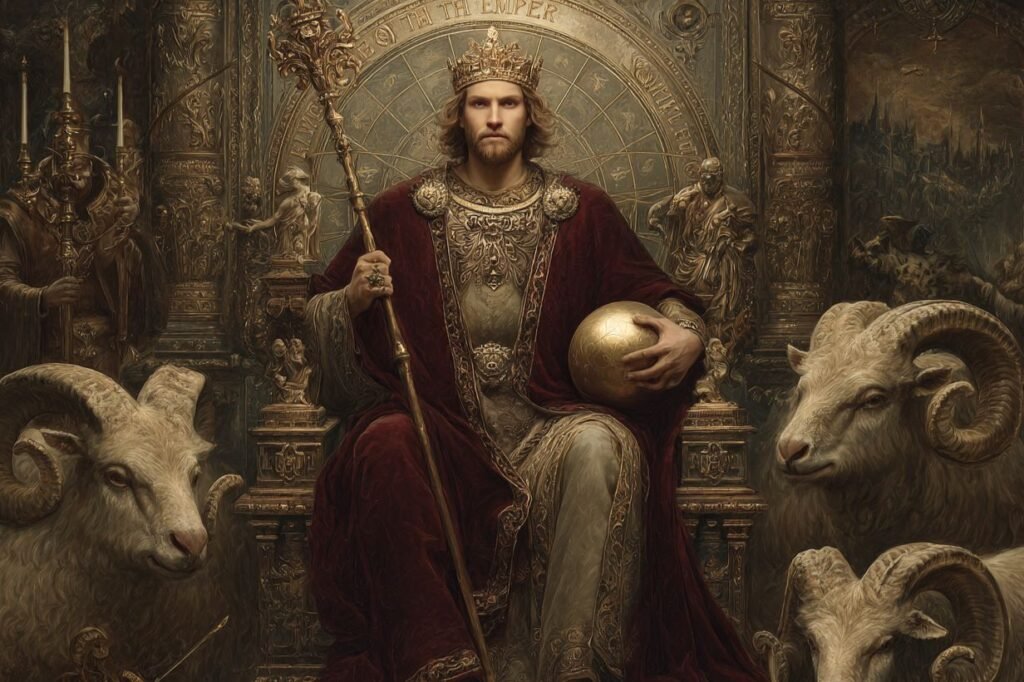
The Emperor tarot meaning centers on structure, internal authority, and the responsible use of power – specifically the power you have over your own life. This is the card of decisions made and held, of boundaries established and maintained, of stability built through consistent action rather than waited for.
The Emperor tarot card represents the experience of genuine self-governance: the capacity to create order in your own life, to take responsibility for the direction you’re moving in, and to build something stable enough to function as a foundation for everything else.
The Emperor is not the card of control. It is the card of the structure that makes everything else possible – including freedom.
Key Takeaways
- The Emperor tarot meaning centers on structure, responsibility, and the internal authority required to lead your own life.
- This is not a card of domination. It is a card of self-governance – the hardest kind.
- The Emperor builds order not because chaos is intolerable, but because genuine stability makes real life possible.
- Upright: it’s time to take responsibility, make decisions, and create structure that actually holds. Reversed: either overcontrol driven by fear, or the avoidance of responsibility that produces its own kind of chaos.
- Structure is not the opposite of freedom. For most people, it is the condition that makes freedom sustainable.
- The authority this card points to is internal – not over others, but over yourself.
- Real stability is built, not given. The Emperor knows this, and acts accordingly.
What Does The Emperor Tarot Card Mean?
The Emperor tarot card means it’s time to take responsibility for the direction things are moving – and to create the structure that makes that direction sustainable.
This card appears when what’s needed is not inspiration, or feeling, or patience, but the specific act of deciding. Taking authority. Making the call and holding it. Building something with enough structure that it can withstand pressure rather than collapsing under it.
It is not a card for the person who needs to loosen up. It is the card for the person who has been living without enough structure, deferring decisions, avoiding responsibility, and feeling the cost of that – or for the person whose structure has become so rigid that it’s turned from support into prison.
It is the card of the person who decides to lead their own life.
Core Meaning
The Emperor tarot card represents the experience of genuine authority – not the kind imposed on others, but the kind exercised over yourself.
He is numbered four in the major arcana – after The Empress’s embodied flow and before The Hierophant’s structured wisdom. Between receptive creation and institutionalized knowledge, there is decision. There is structure. There is the specific discipline of saying this is how it will be, and then holding that through the various pressures that will test it.
What The Emperor describes is not easy authority. It is not the authority of someone who has never been challenged, never been afraid, never felt the pull toward avoidance. It is the authority that exists alongside all of those – that functions despite the discomfort of responsibility rather than in the absence of it.
Structure, in this card, is not restriction. It is the framework within which things can actually grow. The Empress’s wheat doesn’t grow in open air – it grows in soil that has been tended, in a field that has been organized, under conditions that have been created through deliberate work. The Emperor is the condition that makes The Empress’s abundance possible.
→ The Emperor is the card of the person who builds the structure others will eventually inhabit – starting with their own life.
Deeper Meaning
Here’s what rarely gets examined about The Emperor: the thing it’s pointing to is not a desire for power.
In most cases, it is pointing to the avoidance of responsibility – and the specific way that avoidance creates exactly the chaos it was meant to escape. The person who doesn’t make decisions lives inside the decisions that get made for them by default. The person who doesn’t create structure lives inside the entropy that structure would have contained. The refusal of authority is never neutral. It always produces something – usually something less intentional than what deliberate governance would have created.
You cannot opt out of structure. You can only choose between the structure you build and the chaos that fills the space.
There is also something The Emperor touches that is genuinely complex: the relationship between control and anxiety. For some people, the impulse toward structure and control is not a healthy exercise of authority but a response to fear. The person who controls everything because they cannot tolerate uncertainty. Who maintains rigid systems not because those systems serve their life but because the thought of loosening them is intolerable. Who imposes structure on others — their environment, their relationships, their work – because the feeling of things being uncontrolled is experienced as genuine threat.
This is the Emperor’s shadow. And it deserves to be named clearly, because it looks like strength and is actually fear in highly organized clothing.
The difference between structure and overcontrol is whether it serves the life or protects the ego from anxiety.
There’s a third dimension here: the question of internal versus external authority. Most people have a complicated relationship with authority because most of their experience of it has been external – from parents, institutions, systems, other people. And that experience is mixed. Authority has been arbitrary, inconsistent, punitive, self-serving. The natural response to that experience is some combination of rebellion (against authority) and compliance (to authority) – both of which are oriented outward, toward the authority figure.
The Emperor asks about something different: the authority that comes from inside. The capacity to govern yourself – to make decisions, hold them, adjust them when they’re wrong, and take full ownership of the outcomes without either blaming external authority for what goes wrong or waiting for external permission to move forward.
Internal authority is not inherited. It is developed – through practice, through consequence, through the accumulated experience of making choices and living with what they produce.
Symbolism
The Rider-Waite image of The Emperor is the most architecturally deliberate in the major arcana – and its construction is doing specific psychological work.
He sits on a stone throne, not cushioned or ornate but solid and ancient. The throne is not comfortable. It is not designed for ease. It is designed to hold – to provide the stable base from which governance is possible. Comfort is for when the work is done. This is the work.
The mountains behind him are the most honest element in the image: harsh, grey, unyielding. They do not soften for the Emperor’s presence. They do not become easier because he has authority. They are exactly what they always are – the reality of things, which does not yield to preference or expectation. The Emperor sits in front of them, not in spite of them. His authority is not about controlling the mountains. It is about functioning in their presence.
His armor is visible beneath his robes. He has not removed it. This is sometimes read as emotional unavailability, and in the reversed card, that reading is relevant. But in the upright position, the armor is protection in the truest sense: the structure that allows engagement with difficulty without being destroyed by it. You cannot lead – yourself or anything else – if you are entirely vulnerable to every impact.
The red of his robe is not aggression. It is will: the active, directed force of someone who has decided what they’re doing and is doing it. Not impulsively – deliberately. The red of The Magician’s energy organized into The Emperor’s sustained direction.
He holds an ankh in one hand and an orb in the other. The ankh: life organized, sustained, structured. The orb: authority that contains rather than simply dominates. Together, they represent power in the service of life – which is the only version of power The Emperor recognizes as legitimate.
Upright Meaning
When The Emperor appears upright, something requires genuine decision and deliberate structure – and the card is asking whether you’re willing to provide it.
This is not a card that asks you to feel your way forward. It asks you to decide. To choose a direction, build the structure that supports it, and hold that structure through the pressures that will test it. The holding is the work. Not the initial decision – the sustained commitment to the direction that decision established.
What this card describes in upright position is the experience of genuine self-governance: the specific authority of someone who has stopped waiting for external permission or internal certainty and has instead chosen to lead themselves forward.
Common real-life appearances:
- Making a significant decision that has been deferred – and then holding it, rather than immediately second-guessing it
- Creating a structure – in your work, your finances, your creative practice, your physical life — that is stable enough to actually function
- Taking responsibility for something that has been easier to not quite own: a relationship dynamic, a professional situation, a pattern in yourself
- Setting a boundary and maintaining it, not once but consistently over time
- Leading something – a project, a team, a household, a version of your own life – with enough authority that others can rely on what you’ve said
- Deciding that if order is going to exist here, you’re going to have to create it rather than wait for it
→ Upright, The Emperor means the time for deliberating is over – and the work of building and holding has begun.
Reversed Meaning
The Emperor reversed does not mean weakness. It means a specific distortion of the card’s energy – and there are two distinct directions it can take, which look quite different.
The first is overcontrol: structure that has become excessive, rigidity that has passed from useful to constraining, authority that is exercised not in service of something but as an end in itself. This is The Emperor’s shadow – the person whose need for control has exceeded the needs of the situation, and who maintains structures and rules and requirements not because they serve life but because letting them go would expose the anxiety underneath.
The Emperor reversed meaning in this direction includes:
- Controlling behavior in relationships – needing the situation to be a particular way because deviation feels threatening
- Emotional suppression maintained under the guise of strength – the person who has organized themselves out of feeling anything
- Rigidity in the face of evidence that a different approach is needed – staying the course past the point where the course is serving anything
- Authority exercised to protect the ego rather than to achieve anything real
The second direction is the opposite: the avoidance of structure and responsibility that leaves everything unstable. This version is less obvious than overcontrol because it doesn’t announce itself as a problem. It announces itself as freedom, or flexibility, or going with the flow – right up until the cost of no structure becomes impossible to ignore.
This version shows up as:
- Chronic inability to make decisions and hold them – decisions that get revisited repeatedly, reversed, avoided
- The absence of reliable structure in daily life producing the specific anxiety that reliable structure would have prevented
- Responsibility consistently deferred until it becomes a crisis
- The pattern of starting things and not finishing them – not from lack of capability but from lack of the structural commitment that finishing requires
→ Reversed, The Emperor describes either the structure that has become a cage or the absence of structure that has become chaos.
Real-Life Reflection
The Emperor tends to appear in readings at the moment when the freedom from responsibility has started to feel less like freedom.
The most common version looks like this: nothing is decided. Everything is still possible, still flexible, still open. Plans haven’t been committed to. Structures haven’t been built. And what was once the relief of keeping options open has become the specific exhaustion of nothing being settled. Of every day starting from the same open field with no cleared path through it.
The Emperor arrives at exactly this point. Not to tell you what to decide. To tell you that the deciding itself is what’s needed – that the relief you’re looking for is on the other side of commitment, not in continued avoidance of it.
The other version is the structure that has become its own kind of trap. Everything is organized. Everything is managed. There are systems for everything, rules for everything, expectations that have calcified into requirements. And the person inside all of this organization is more controlled than controlling – more prisoner than architect.
This version is harder to see because it looks like competence. It feels, from inside, like being on top of things. But the rigidity of it, the way it cannot flex, the cost of anything unexpected – these are the signals that the structure has overgrown what it was built to contain.
Love and Relationships
In love, The Emperor tarot meaning describes the specific quality of stability that makes genuine intimacy possible – as opposed to the instability that makes even simple connection feel like it’s happening on shifting ground.
Real emotional safety in a relationship is not the absence of conflict. It is the presence of consistent, reliable behavior from someone who has decided to be there. The Emperor in a relationship is the person who does what they say they’ll do. Who shows up when they’ve committed to showing up. Who holds the framework of the relationship – its agreements, its rhythms, its expectations – with enough steadiness that the other person can relax into it rather than always having to test whether it’s still there.
This is distinct from control. The distinction matters enormously in love, and it’s worth being precise about it.
Control in a relationship is structure imposed for the benefit of the person imposing it. It limits the other person’s movement, expression, or choices in ways that serve the controller’s anxiety rather than the relationship’s health. The Emperor’s energy in love is the opposite: structure built for the benefit of both people, that holds space for genuine connection rather than constraining it.
In relationships, The Emperor can appear as:
- A person who is reliably present – not exciting, but consistently there in a way that creates genuine safety
- The specific stability of a relationship where agreements are made and kept, where the structure is clear enough that both people know where they stand
- The moment when a relationship requires someone to make a real commitment – and the question of whether that commitment will be made
- Boundary-setting in a relationship that has been operating without clear ones – the discomfort of that, and the relief that follows
- Taking responsibility for a dynamic you’ve been participating in without fully owning
The shadow of this card in love is the relationship that is stable and cold. Where reliability has replaced warmth. Where structure has displaced genuine connection. Where someone is committed to the form of the relationship more than to the actual person they’re with.
The question The Emperor asks in relationships: Is the structure you’ve built creating space for real connection – or substituting for it?
Career, Money, and Work
In career readings, The Emperor tarot meaning points to the moment when something needs to be built – not imagined, not planned indefinitely, but actually constructed with the discipline and consistency that building requires.
This is the card of the long game. Of the professional who understands that what is worth building takes time, that sustainable structures are built through consistent effort rather than sudden breakthrough, that the work of today contributes to something that will exist in a year, in five years, in a version of the future that has been considered.
The Emperor in career is not about ambition. It is about discipline applied toward something clear. The difference is significant: ambition without structure produces movement without direction, effort without accumulation. Discipline toward a clear direction produces something that exists after the effort is complete.
Common career appearances:
- Taking genuine leadership – not the title, but the actual function of setting direction, making decisions, and being accountable for outcomes
- Creating a sustainable professional structure after a period of working without one – regular hours, consistent systems, clear priorities
- Making a strategic decision that requires committing to one direction and relinquishing the others
- Building something long-term – a career, a practice, a business – with the patience that real building requires
- Taking financial responsibility: budgets, plans, the honest accounting of where things are rather than where you’d like them to be
Financially, The Emperor is the most straightforward card in the deck: it asks for honest structure. Budget. Track. Plan. Commit. Not as punishment, but as the basic structure within which financial reality can be understood and directed.
Spiritual Lesson
The spiritual lesson of The Emperor is the one that most directly challenges the culture of personal development: structure is not the enemy of freedom. For most people, it is the condition that makes freedom real.
The fantasy of freedom is often the freedom from structure – from schedules, responsibilities, commitments, constraints. The reality of freedom, for most people, is more paradoxical: they feel most genuinely free inside a life that has enough structure to be reliable. Where the decisions have been made. Where the commitments have been established. Where the energy that would otherwise go into figuring out what to do next is freed up by the structure that has already answered that question.
The Emperor understands that a well-built cage and a well-built home can look identical from the outside. The difference is who built it, and why.
There is also something The Emperor teaches about the relationship between authority and responsibility. Real authority – not the performed kind, not the kind that requires external validation to feel real – comes from the experience of making decisions and holding them. Of being accountable for outcomes and adjusting when necessary. Of being the kind of person whose word means something, starting with yourself.
This is developed. It is not inherited. And it is developed through practice – specifically the practice of making commitments and keeping them, which builds both the reliability others experience and the internal authority the Emperor describes.
The Emperor’s authority is not given. It is earned through the consistent experience of being someone who does what they say.
Energy of the Day
An Emperor day has a quality of focused steadiness that is different from ordinary productivity.
Things feel clarified. Decisions that have been sitting in the peripheral vision become easier to make because the day has a quality of directness that doesn’t accommodate indefinite postponement. Distractions register more clearly as distractions. The distinction between what matters and what is merely urgent becomes more navigable.
There may be a pull toward creating or reinforcing structure – organizing the workspace, establishing the schedule, clarifying the agreements, making the plan concrete rather than general. Not from anxiety, but from the genuine satisfaction of having things in order.
On an Emperor day: make the decisions you’ve been avoiding. Establish the structure that has been theoretical. Take responsibility for the thing that has been slightly everyone’s problem and therefore no one’s problem. The quality of clarity available today is not an accident – it is a resource to be used.
This is not a day for exploration. It is a day for commitment.
Advice
The Emperor’s advice is precise and carries a specific kind of weight – the weight of genuine accountability.
Take responsibility for what is yours. Not to be punished by it, but to be freed by it. The decisions that haven’t been made, the responsibilities that haven’t been fully owned, the structures that haven’t been built – they are costing more in maintenance and anxiety than taking ownership would cost in effort. Deciding is almost always lighter than indefinitely not deciding.
Structure is not something that happens to you. It is something you build – or live without.
Create the structure before you need it. Most people wait until the absence of structure has become a crisis before they address it. The Emperor’s approach is different: build the framework when things are stable enough to build thoughtfully, rather than scrambling to create it under pressure. A schedule, a budget, a decision-making process, a set of clear agreements – these are easier to build before they’re urgent.
Set boundaries and hold them. Not as performance, not as punishment, but as honest communication about what you are and aren’t available for. Boundaries that are stated and not held are worse than no boundaries – they teach people that your limits are suggestions. Boundaries that are held consistently become part of the stable architecture that both you and others can rely on.
Stop waiting for certainty before you commit. The Emperor does not act from certainty. He acts from decision – and then creates the conditions that make the decision viable. The certainty you’re waiting for will not arrive before you commit. It will arrive, if at all, after.
The authority you’re looking for is not something anyone can give you. It is built from the inside, through the accumulated experience of saying what you’ll do and doing it.
Why This Card Keeps Appearing
If The Emperor keeps appearing in your readings, something is consistently not being decided, not being structured, or not being owned – and the pattern has persisted long enough to become the condition.
This card recurs most often in two situations.
The first is the avoidance of responsibility. Not dramatic avoidance – the quiet kind. The decisions that get deferred until they’re made by default. The structures that never quite get built because there’s always something more pressing. The leadership of your own life that somehow keeps not quite being exercised, leaving the direction of things to be shaped by everything except genuine intention.
The second is overcontrol. The Emperor keeps appearing when the structure that was built to serve has become the thing everything else serves. When the systems are rigid enough to function but not alive enough to grow. When the authority being exercised is not building anything but simply maintaining itself.
The Emperor repeats because the structure it’s pointing to keeps either not being built or not being built for the right reasons.
Sometimes it appears repeatedly when someone is very close to a genuine commitment – to a direction, a decision, a version of their life – and keeps stopping just before it. The card is not pointing at a distant possibility. It is pointing at the next decision. The one that’s available to be made right now.
If this card keeps finding you, the useful question is not what it means. It means what it always means. The useful question is: what have you been not quite deciding? And what would it take to actually decide it?
Final Reflection
There is a version of freedom that requires no decisions.
It is the freedom of keeping everything open. Of never committing to any particular direction, never building anything that would make moving on more complicated, never saying yes in the full sense that closes off the other options. It is a kind of freedom, and it has a genuine appeal – particularly for people who have experienced authority as arbitrary or commitment as trap.
But it is also the freedom of an empty field. Possible. Undirected. Without the structures that would make the possibility into something real and inhabitable.
The Emperor is the card of choosing to build. Of looking at the open field and deciding that something should exist there – a structure, a direction, a committed life – and then doing the work to create it. Not because the open field is wrong, but because a built life, with all its commitments and constraints and responsibilities, offers something the open field cannot: the experience of actually living in something you’ve made.
Structure is not the prison. Endless postponement is.
The freedom worth having is not the freedom from commitment. It is the freedom that comes from being so clear about your direction, so reliable in your behavior, so honest about your limits, that you don’t have to spend your energy managing the consequences of ambiguity.
Build the structure. Lead the life. The rest follows from that.
Frequently asked questions about the Emperor tarot card
What does The Emperor tarot card mean?
The Emperor tarot card means structure, internal authority, and responsible self-governance. It is the card of making decisions and holding them, of building the framework that makes a stable life possible, and of taking genuine ownership of the direction things are moving. It is not about control over others – it is about the specific, demanding authority we exercise over ourselves
Is The Emperor a good card?
The Emperor is one of the most affirming cards in tarot when its energy is understood correctly. Upright, it points to genuine stability, clear decision-making, and the kind of authority that builds rather than dominates. Reversed, it can indicate either overcontrol – rigidity and fear masquerading as strength – or the avoidance of structure that leaves everything unstable. Its quality depends entirely on how the authority it describes is being exercised.
What does The Emperor mean in love?
The Emperor tarot meaning in love describes the quality of reliable, consistent presence that creates genuine emotional safety. It is the card of the partner who does what they say, who holds the structure of the relationship steadily, and whose consistency allows real intimacy to develop. The shadow is the relationship where stability has replaced warmth, or where reliability has tipped into control – maintaining the form of the relationship while losing contact with the actual person.
What does The Emperor reversed mean?
The Emperor reversed meaning points to one of two distortions: overcontrol, where structure has become rigidity and authority is exercised from anxiety rather than genuine governance; or the avoidance of structure, where decisions keep being deferred, responsibilities keep being avoided, and the chaos that results is experienced as the default condition rather than the result of choices made. Both are the same dynamic with opposite expressions.
Why do I keep getting The Emperor?
If The Emperor keeps appearing, something is consistently not being decided, not being owned, or not being organized – and the absence is costing more than building it would. The card recurs when responsibility is being deferred, when structure is being avoided, when the authority over your own life is being left to default rather than deliberately exercised. It also recurs when existing structure has become excessive – when the control is protecting anxiety rather than serving life.
What is The Emperor trying to tell me?
The Emperor is usually telling you that something needs to be decided – and held. That the structure you’ve been meaning to create is overdue. That the responsibility you’ve been almost-owning needs to be owned fully. Not as a burden, but as the specific form of authority that would allow everything else to be more stable. It is asking you to stop waiting for someone or something else to organize this – and to do it yourself.
Want to understand Tarot on a deeper level?