The Hierophant doesn’t arrive when you’re questioning.
It arrives before the questioning begins – in the long period when you’re not questioning, when the rules are just the rules, when the way things are done is simply the way things are done, and you haven’t yet thought to ask why.
Most of what people believe, they didn’t choose. They inherited it. From family, from school, from culture, from religion, from the specific social context that shaped the early years – the years when belief is absorbed rather than decided. The values, the definitions of success and failure, the rules about what is acceptable and what isn’t, the understanding of what a relationship should look like, what a career should be, what a good person does – almost none of this arrived through independent inquiry. It arrived through transmission. And most of it has been operating quietly ever since, shaping decisions and judgments without ever quite surfacing as a belief that could be examined.
This is what The Hierophant is pointing at. Not tradition as an obstacle. Not authority as something to be overcome. But the specific reality that most of what shapes human behavior is learned – and that learned things, if they’re never examined, tend to run on their own.
The Hierophant tarot meaning is about what you believe, where it came from, and whether the two things are the same.
Quick Answer
The Hierophant tarot meaning centers on belief systems, structured learning, and the relationship between inherited meaning and personal truth. This is the card of the frameworks – religious, cultural, educational, familial – that shape how people understand themselves and the world, and of the specific question those frameworks eventually ask: do you actually believe this, or did you just never get around to questioning it?
The Hierophant tarot card represents both the genuine value of learning through existing systems and the limitation those systems can become when they’re held as absolute rather than as one way among others. It is the card of guidance received – and of the eventually necessary work of figuring out which of it is genuinely yours.
The Hierophant is not a card about tradition. It is a card about meaning – and about where yours actually comes from.
Key Takeaways
- The Hierophant tarot meaning centers on belief systems, inherited values, and the structures through which meaning gets transmitted.
- This is not a card of blind obedience – nor a card of rebellion. It is a card about the relationship between what you’ve been taught and what you’ve actually chosen.
- The Hierophant asks a question most people avoid: do you believe this because it’s true for you, or because you’ve never examined it?
- Upright: learning from a system, a mentor, or an established path – with genuine benefit. Reversed: either conformity past the point of authenticity, or rebellion that has thrown out real value along with what needed to go.
- The discomfort of this card is not the structure. It is the moment of realizing how much of your inner life was built by someone else.
- Learning through systems is not weakness. Remaining entirely inside them without examination is.
- The Hierophant’s real work is not transmission. It is the invitation to eventually develop your own.
What Does The Hierophant Tarot Card Mean?
The Hierophant tarot card means you are inside a system of meaning – and the question is whether you’re aware of it.
This card appears when belief systems, structures of understanding, or inherited values are central to the situation. When what you’ve been taught is shaping what you see, what you decide, or how you define what’s acceptable. When a mentor, institution, or established path is providing – or being asked to provide – the framework within which the situation is being understood.
It is the card of knowledge transmitted through structure, and of the moment when that transmission asks to be examined: not discarded, not defended, but actually looked at.
Core Meaning
The Hierophant tarot card represents the experience of receiving meaning through an existing system – and the specific relationship with authority and understanding that creates.
He is numbered five in the major arcana – after The Emperor’s structural governance and before The Lovers’ individual choice. Between organized authority and personal decision, there is inherited belief. The Hierophant holds that space: the vast territory of what people understand, value, and live by before they’ve had occasion to question whether those things are actually theirs.
This is not small territory. Most of what most people believe arrived this way. And there is genuine value in it: systems of meaning – religious, educational, cultural, philosophical – carry accumulated wisdom about how to live, what matters, what holds communities together, what allows individual life to make sense in a larger context. None of this is nothing. The Hierophant is not a card to be dismissed.
But the card’s deeper work is not the transmission. It is the moment after transmission when the question becomes: and what do you, specifically, actually make of this?
→ The Hierophant is the card of received meaning – and of the inevitably personal work of deciding what to do with it.
Deeper Meaning
Here’s what rarely gets examined about The Hierophant: the thing it’s pointing to is not external authority. It is the authority that has become internal without quite being chosen.
The beliefs that shape us most completely are not the ones we hold consciously. They are the ones so thoroughly absorbed that they no longer feel like beliefs – they feel like facts. The understanding that certain kinds of work are real work and others aren’t. The definition of what makes a relationship legitimate. The specific judgments that arrive automatically when someone behaves in a particular way. The rules that operate without requiring consultation because they’re simply part of the operating system.
Most of this was installed before there was much capacity to choose it.
The Hierophant asks not what you believe – but when you last checked whether you’d actually decided to.
This is where the card gets genuinely uncomfortable. Because examining inherited beliefs is not an intellectual exercise. It is a threat to identity. The values and frameworks that were absorbed early became part of the architecture of the self – the structure inside which the rest of life was built. To question them is not to consider an idea. It is to potentially destabilize the foundation.
Which is why most people don’t. Or don’t until something forces it.
The Hierophant is also about the specific psychological comfort of external authority. Having someone – a teacher, a tradition, an institution – tell you the right way to do something is a genuine relief. It removes the weight of having to figure it out yourself. It provides the stability of a shared framework, the belonging that comes from operating inside a system that others also operate inside, the sense that you are doing things correctly by a standard that exists outside of you.
The need for external guidance is not immaturity. It is a genuine human need – and one that can be genuinely met, or genuinely exploited.
The difference between guidance that supports development and authority that prevents it is specific: guidance that supports development eventually becomes unnecessary. The good teacher is working toward their own irrelevance – toward the student who no longer needs the teacher because they’ve developed their own understanding. The authority that prevents development does the opposite: it structures the relationship so that the need for it is permanently maintained.
There’s also the shadow on the other side: the rejection of all structure in the name of authenticity. The person who, having realized that their beliefs were inherited rather than chosen, concludes that inherited beliefs are therefore invalid – and throws away real wisdom along with the conditioning. This is the Hierophant reversed in its rebellion direction, and it’s worth taking seriously, because it produces people who are free of their previous framework and floating without any coherent one to replace it.
Rebellion against meaning is not the same as developing your own.
Symbolism
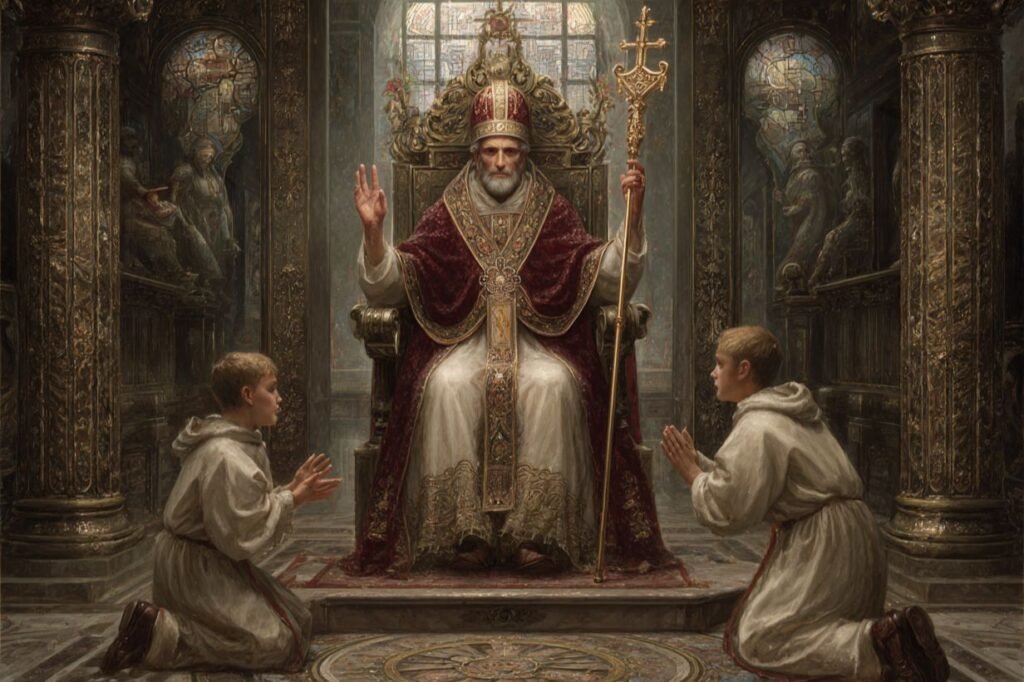
The Rider-Waite image of The Hierophant is the most institutionally structured in the major arcana – and its formality is doing specific psychological work.
He sits elevated between two pillars, in full ceremonial regalia, with two figures kneeling before him in submission. He raises one hand in a specific gesture of blessing and teaching – the two fingers raised, the three fingers down – a transmission of knowledge according to a structure, a system, a particular way of understanding what is sacred and how it is to be approached.
The pillars on either side are not labeled black and white as in The High Priestess. They are identical – both the same. This is not the card of dynamic opposition or interior tension. It is the card of institution: the same on both sides, the same from all perspectives, the specific stability of a framework so established that it no longer varies.
At his feet, two keys lie crossed. Not on a wall, not held – on the floor, accessible. The keys represent access to knowledge through the system: the understanding that this framework, followed, unlocks something real. The knowledge is not hidden. But it is accessed through the structure, not around it.
The two figures kneeling before him wear robes decorated with roses and lilies – desire and purity, the two motivations that bring people to systems of meaning. They are receiving transmission. They are in the position of learner, of initiated, of someone inside the framework being shaped by it.
The Hierophant himself is enormous in the frame – formal, established, unmoving. He is exactly what the card describes: a system so fully embodied that it has become a presence. Not a person making choices, but a function being fulfilled.
The psychology of this image is pointed: it asks whether you are the figure on the throne, the figures at his feet, or somewhere in the complex territory between.
Upright Meaning
When The Hierophant appears upright, a system of meaning is either being engaged with productively or being asked to be.
This is not always about religion or tradition in the conventional sense. It can be any structured framework of understanding: an educational system, a professional discipline, a therapeutic approach, a community of shared values, a philosophical tradition, a mentor relationship. The common thread is that the framework is external to you, is established, and carries genuine value that can be received through genuine engagement.
The upright Hierophant is not the card of blind conformity. It is the card of someone who is learning through structure – who is inside a framework and receiving something real from it.
Common real-life appearances:
- Learning a field, craft, or discipline through its established methods, before developing your own approach
- Working with a therapist, coach, mentor, or teacher who provides genuine guidance toward development
- Finding genuine belonging in a community organized around shared values
- Following an established professional path because it leads somewhere worth going
- Engaging seriously with a tradition – religious, philosophical, cultural – rather than sampling from it superficially
- Recognizing that some of what you were taught is actually right, not just familiar
→ Upright, The Hierophant means the structure being engaged with has genuine value – and the invitation is to receive it rather than resist or bypass it.
Reversed Meaning
The Hierophant reversed does not mean tradition is being abandoned. It means the relationship with structure has become distorted – in one of two distinct directions.
The first is the over-identification with systems that produces a loss of self. This is the version where the framework is no longer guidance but identity – where the person has merged so thoroughly with the belief system, the institution, the tradition, the role that what they think, feel, and choose has become entirely its expression. There is no remainder. No part of them is asking whether this is actually theirs.
The Hierophant reversed meaning in this direction includes:
- Following rules without examining why – or noticing that following them is causing harm
- Seeking external approval for every significant decision because independent judgment has never been developed
- Defining oneself entirely through a system, role, or institution to the point where stepping outside it feels like nonexistence
- Participating in the transmission of beliefs that have not been personally examined
The second direction is reactive rebellion: the rejection of all structure, all authority, all inherited meaning – not as a result of careful examination but as a response to having felt constrained by it. This can look like freedom. It often produces a different kind of limitation.
This version shows up as:
- Refusing all guidance because guidance has felt like control – and consequently having no real direction
- Rejecting inherited beliefs entirely before examining which elements were actually valuable and which were genuinely problematic
- A suspicion of any structured framework – any mentor, institution, community – based on previous experience of structure as limitation
- The specific intellectual position that anything received from tradition is therefore suspect
→ Reversed, The Hierophant describes either the self that has been absorbed into a system or the self that has been built in reaction to one.
Real-Life Reflection
The Hierophant tends to appear in readings at the moment when the inherited framework meets the lived experience – and they don’t quite match.
The most common version looks like this: you have been operating inside a set of beliefs about what is right, what is acceptable, what success looks like, what relationships should be, what you owe to the people around you. These beliefs came from somewhere – family, culture, religion, education. They have shaped your choices. And now something in your actual life is pulling against them.
Not in a dramatic confrontation. In the quieter form: a decision you’re supposed to make that feels wrong in a way the framework doesn’t account for. A situation that the inherited understanding doesn’t quite fit. A persistent sense that the rule you’re following is someone else’s rule, applied to a situation they didn’t have in mind when they made it.
The Hierophant arrives at this moment to ask a genuine question: is this belief actually yours – and if so, why?
The other version is the absence of any framework: the person who has rejected inherited belief without replacing it with examined belief, and who is consequently navigating entirely without the benefit of accumulated wisdom – either their own or anyone else’s. This isn’t freedom. It is a different kind of being lost.
Love and Relationships
In love, The Hierophant tarot meaning describes the role that structure, shared values, and social context play in relationships – which is considerably larger than most people acknowledge.
Relationships don’t exist in a vacuum. They are shaped by the frameworks both people bring to them: the definitions of what a committed relationship looks like, what the appropriate pace of development is, what the roles of the people involved are or should be, what constitutes a valid form of partnership. These frameworks arrived from somewhere – usually from family of origin, cultural context, and the specific social worlds in which each person learned how relationships work.
When two people’s inherited frameworks align, there’s a quality of ease that often gets mistaken for natural compatibility. When they don’t, the friction is often attributed to the people when it’s actually between the systems.
In relationships, The Hierophant can appear as:
- A relationship that follows a clear, socially recognized structure – engaged, committed, institutionally validated – and the question of whether that structure serves both people or simply satisfies the external framework
- The pressure to formalize something – to make it official, to meet others’ expectations about where it should be by now
- Shared values that provide a genuine foundation for a lasting connection
- The conflict between what both people feel and what they’ve been taught a relationship should look like
- A partner who operates from a very different framework and the specific challenge of navigating across that difference
The question The Hierophant asks in love: Is this relationship built on what you actually believe about commitment – or on what you were taught to expect?
Career, Money, and Work
In career readings, The Hierophant tarot meaning points to the role that established paths, professional institutions, and received wisdom about how careers should work play in the current situation.
For many people, the framework for how a career should develop was inherited as thoroughly as any other belief: from parents’ definitions of stable and respectable work, from educational systems that valorize certain kinds of competence and achievement, from industries that have established norms about how advancement happens and what constitutes success. Most people follow these frameworks without quite realizing they’re frameworks – they feel like simply the way things work.
The Hierophant in career is not a card against institutions or established paths. It is a card that asks whether the path being followed is the one that actually serves this person, in this life, or the one that was available when the decision was made.
Career appearances:
- Pursuing a credential, degree, or professional certification – the formal transmission of knowledge through established structure
- Working within an institution and learning its systems before developing your own approach
- Following a recognized career path because it leads somewhere valuable – rather than abandoning it in favor of something with less friction but less direction
- The tension between the conventional career path and something less established that feels more genuinely aligned
- Recognizing that the professional framework you’ve been inside has given you real skills – and that those skills can now be applied differently
Financially, The Hierophant describes the relationship with established financial frameworks: the conventional wisdom about how money should be managed, what financial security means, what the right approach to investment and saving is. It asks whether those frameworks are actually yours or simply received – and whether following them is producing the results they promised.
Spiritual Lesson
The spiritual lesson of The Hierophant is the one that requires the most nuance of anything in the major arcana: learn from systems, but do not mistake them for the truth they’re pointing at.
Every tradition, every teaching, every framework of meaning is a map. Maps are genuinely useful. They carry accumulated knowledge about terrain that would take a lifetime to discover independently. Following a map is not weakness – it is the intelligent use of others’ experience.
But the map is not the territory. And the person who has memorized the map without actually traveling the terrain has something that resembles knowledge and is missing something essential.
The Hierophant’s wisdom is transmitted. Your understanding of it must be lived.
There is also something this card teaches about the relationship between guidance and independence. Most genuine development requires both: a period of receiving – genuinely receiving, not just sampling – the wisdom that a system has to offer, and then the work of making that wisdom personally real rather than doctrinally held. The person who has genuinely absorbed a tradition and developed their own relationship with it is different from the person who has followed the rules. And both are different from the person who rejected the tradition before they understood what it was offering.
The spiritual work The Hierophant points to is the examination: going through what you believe and asking, with real honesty, which elements are genuinely yours – which have been tested against your lived experience and found real – and which are simply inherited, operating on their own, never quite examined.
What you believe shapes everything. It is worth knowing what you actually believe.
Energy of the Day
A Hierophant day has a quality of structure and reflection that is different from ordinary thoughtfulness.
There may be an inclination toward learning – toward receiving rather than generating. A conversation with someone more experienced that carries unusual weight. An encounter with a text, a tradition, or a framework that presents something worth actually sitting with rather than moving past. The pull toward engaging with something established, rather than producing something new.
There may also be the quiet surface of a belief examined. Something said, or read, or encountered that causes a momentary pause – where you notice you have a strong response to it and then wonder where the response came from. What you actually think, as opposed to what you automatically think.
On a Hierophant day: allow the learning. If a system, a teaching, or a mentor has something to offer, receive it rather than immediately evaluating whether it aligns with what you already think. And if a belief surfaces that hasn’t been examined recently, take a moment to look at it – not to discard it, but to know it better.
Advice
The Hierophant’s advice is measured and, in the characteristic style of this card, comes through structure rather than impulse.
Question what you’ve accepted as truth – not to destroy it, but to know it. The beliefs that shape your life most thoroughly are usually the ones you’ve never quite examined because they didn’t announce themselves as beliefs. They felt like facts. The work is to develop enough distance from them to see that they are choices – and then to actually choose, from that distance, what you want to keep.
Understanding where a belief came from is not the same as rejecting it. But you cannot actually choose something you’ve never actually questioned.
Seek guidance, but maintain your own judgment. The presence of a mentor, a system, or an established framework is genuine resource. The question is whether you’re using it to develop your own understanding or using it to avoid the work of developing your own understanding. Good guidance moves in one direction: toward no longer needing it.
Learn before you reject. The impulse to dismiss an inherited system before understanding what it was actually offering often means throwing away real wisdom along with the conditioning. There is usually something in what was taught that is worth knowing, even if the packaging needs to be examined.
Don’t confuse the structure with the meaning. Every tradition, institution, or framework is a container. The container may need to be renegotiated. The meaning it was carrying may be worth keeping, in a different form.
The Hierophant doesn’t ask you to follow. It asks you to understand – which sometimes leads to following, and sometimes leads somewhere else.
Why This Card Keeps Appearing
If The Hierophant keeps appearing in your readings, something about the relationship between received meaning and personal truth is unresolved – and has been for long enough to be a pattern.
This card recurs most often in two situations.
The first is the ongoing reliance on external authority for decisions that require personal judgment. The constant seeking of others’ opinions, frameworks, guidelines – not to inform thinking but to replace it. The inability to reach a conclusion without external validation because independent judgment has not been developed, or has been developed but is not trusted.
The second is the long conflict between what was taught and what is actually experienced as true – the belief that has been maintained past the point of genuine conviction, the role that is being played because it was assigned rather than chosen, the framework that no longer fits but hasn’t been formally released.
The Hierophant keeps appearing because the question it’s asking hasn’t been answered yet.
Sometimes it appears repeatedly when someone is very close to a genuine belief examination – when the inherited framework has been strained enough that the questioning has begun, but the actual work of deciding what is genuinely theirs hasn’t been completed. The card is not pointing at a distant philosophical exercise. It is pointing at a specific belief, a specific framework, a specific authority that is currently shaping the situation and deserves attention.
If this card keeps finding you, the useful question is not what it means. The useful question is: what have you been believing without quite deciding to?
Final Reflection
There is a version of certainty that requires no examination.
It is the certainty of what you were taught – the beliefs that arrived before you had the capacity to evaluate them, that became part of the structure of how you understand the world, that feel less like conclusions you’ve reached and more like the ground you’re standing on. This certainty is comfortable. It provides the sense of knowing where you are and what is expected and what things mean. And most of it arrived without your permission.
The Hierophant is the card that eventually asks you to look at that.
Not to destroy it. Not to reject everything that came from somewhere other than your own independent inquiry – which would leave you with almost nothing, because almost everything humans know was received from somewhere. But to actually look. To know what you believe and why you believe it. To have, at some point in your life, made a genuine choice rather than simply a continuation of what was already operating.
Most people’s beliefs are a mixture: some inherited and genuinely chosen upon reflection, some inherited and never examined, some examined and found wanting, some developed through experience, some held out of belonging, some held out of genuine conviction.
The Hierophant asks you to know the difference.
What you live by shapes everything. It deserves to be something you’ve actually decided on.
Frequently Asked Questions about the Hierophant tarot card
What does The Hierophant tarot card mean?
The Hierophant tarot card means inherited belief systems, structured learning, and the relationship between received meaning and personal truth. It is the card of the frameworks – religious, cultural, educational, familial – that shape how people understand themselves and the world, and of the question those frameworks eventually ask: is this actually yours, or did you simply never examine it?
Is The Hierophant a positive card?
The Hierophant is neither simply positive nor negative – its quality depends entirely on the relationship it describes. Upright, it points to genuine value in learning through established systems, receiving guidance, and belonging to communities of shared meaning. Reversed, it can indicate either the loss of self inside a system that has become total identification, or the rejection of all structure in a way that throws out real wisdom. The card is honest about both possibilities.
What does The Hierophant mean in love?
The Hierophant tarot meaning in love describes the role of structure, shared values, and inherited frameworks about relationships in the current situation. It can indicate the pressure to formalize or conventionalize a connection, the genuine foundation that shared values provide, or the conflict between what both people feel and what they’ve been taught a relationship should look like. The central question is whether the relationship structure being inhabited is one that genuinely serves both people or one that satisfies an inherited framework.
What does The Hierophant reversed mean?
The Hierophant reversed meaning points to one of two distortions: over-identification with a system, role, or tradition to the point where independent judgment has been suppressed or abandoned; or reactive rebellion against structure, where inherited frameworks have been rejected wholesale without the work of figuring out what was actually worth keeping. Both represent a distorted relationship with external authority – either too much or too aggressively opposed.
Why do I keep getting The Hierophant?
If The Hierophant keeps appearing, the relationship between received belief and personal truth is unresolved. The card recurs when external authority is being relied on for decisions that require personal judgment, when an inherited belief system is still operating without having been examined, or when the tension between what you were taught and what you actually experience as true has not been fully engaged with. It keeps appearing because the question it’s asking hasn’t been answered yet.
What is The Hierophant trying to tell me?
The Hierophant is usually telling you that something you believe – and are living by – deserves examination. Not rejection, but genuine examination: where did this come from, is it actually true for you, have you chosen it or simply never gotten around to questioning it? It may also be pointing toward guidance that is genuinely available and worth receiving – a system, a mentor, a tradition that has something real to offer if engaged with honestly rather than bypassed or absorbed without reflection.
Want to understand Tarot on a deeper level?