No. It doesn’t mean someone is going to die.
Let’s get that out of the way immediately, because it’s the first thing almost everyone thinks when this card appears – and the fear tends to swallow everything else before the actual meaning has a chance to land.
The Death card does not predict physical death. In decades of tarot reading, experienced practitioners will tell you the same thing: this card almost never refers to literal death. What it refers to is something that, depending on where you are in your life, can feel just as significant.
It refers to endings. Real ones. The kind that don’t leave a door open behind them.
And here’s the thing about endings – the real, complete, no-going-back kind: they are not the opposite of life. They are part of it. Nothing new can begin without something ending first. The Death card is not the card of loss. It is the card of transformation. And transformation, almost without exception, requires you to let something die.
Card XIII of the Major Arcana is one of the most misunderstood cards in the deck. Once you understand what it’s actually saying, it becomes one of the most liberating.
What does the Death tarot card mean?
Death represents endings, transformation, transition, release, and the irreversible completion of one phase so that another can begin. It is the card of necessary change – not optional, not gentle, not something you can negotiate your way around.
This is not a soft card. Death doesn’t offer a compromise. It doesn’t say “maybe later.” It says: this is complete. Whatever this is – a relationship, a career, a belief about yourself, a way of living, an identity you’ve outgrown – it is done. And the question now is not whether to let it go. The question is how.
In a reading, Death typically signals:
- The end of a significant chapter – a relationship, a job, a phase of life, a version of yourself
- A transformation so complete that who you are on the other side will be meaningfully different
- The need to release something that has already ended – even if you haven’t acknowledged it yet
- A clearing – space being made, whether you chose it or not, for what comes next
- Irreversible change that is ultimately in service of growth
Death says: something is over. And everything depends on whether you’re willing to let it be.
Death tarot symbolism: what every detail is telling you
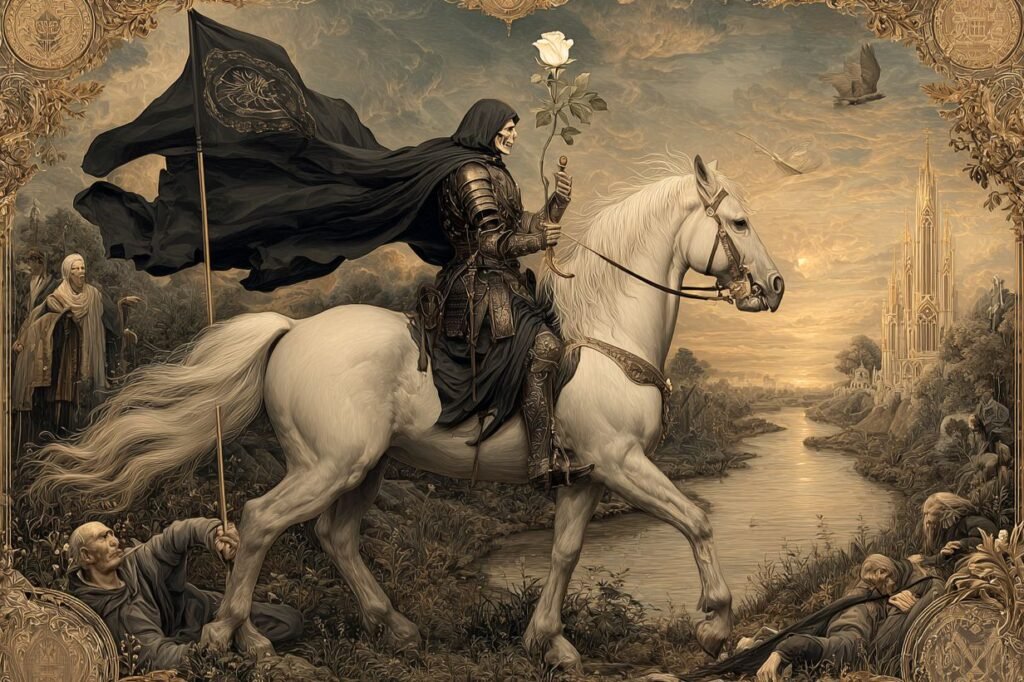
The skeleton knight rides a white horse across a landscape where figures of all stations – a king lying dead, a bishop praying, a child offering flowers, a woman turning away – all meet him. Death comes for everyone. It does not distinguish by rank, by status, by how much you’ve prepared, or by how hard you’ve tried to avoid it.
The white horse is significant. White – not black, not grey. White is the color of purity, of new beginnings, of something clean. The horse that carries Death is not a symbol of evil. It is a symbol of transformation moving through the world with inevitability and, in its own way, with grace.
The black flag with the white rose is one of the most misread symbols on the card. The rose is not a consolation prize. It is the point. The white rose on a black flag says: within the ending, there is purity. Within the darkness, there is something that survives. Not everything – but something essential, something real, something that belongs to the next chapter rather than the last one.
In the background, the sun sets between two towers – but it also rises. This is the same sun that will appear again in The Sun card later in the Major Arcana. The light hasn’t gone out. It has moved to the other side. What looks like an ending from this position is, from a longer view, a turn in a cycle.
The bishop faces Death with his hands clasped – accepting. The child offers flowers – unafraid, present. The woman turns away – the only figure who refuses to look. Her position in the card is quietly telling: avoidance doesn’t stop the horse. It just means you don’t see it coming.
Death reversed: when endings get stuck
Reversed, Death is one of the most revealing cards in the deck – because it shows you exactly where you are holding on.
This is the relationship that ended eighteen months ago that you’re still processing as though it’s ongoing. The career you left – or that left you – that you’re still defining yourself by. The version of yourself from ten years ago that you keep trying to resurrect because the current version feels unfamiliar and uncertain. The grief that has calcified into identity because letting it go would mean you’d have to figure out who you are without it.
The reversed Death can show up as:
- Resistance to an ending that has already happened – refusing to accept that something is over
- Clinging to the past – a relationship, an identity, a version of life – that no longer exists
- Fear of change so deep that you’re keeping yourself in a state that has already completed
- A transition that has stalled – the old has ended but the new hasn’t been allowed to begin
- Stagnation that comes not from lack of movement but from refusing to move in the direction required
The reversed Death asks: what have you been treating as ongoing that is actually already over? What ending are you refusing to accept? And – most pointedly – what are you afraid will happen if you finally let it complete?
Because underneath most resistance to endings is not attachment to what’s ending. It’s fear of what comes next. The blank space after the chapter closes. The version of yourself that doesn’t exist yet. The life that hasn’t been defined yet.
The reversed Death says: the blank page is not a threat. It’s the beginning of the next thing. But you have to be willing to close the book you’re in first.
Death in love and relationships
In love, the Death card is one of the most honest cards you can draw – and one that requires real courage to receive clearly.
Sometimes it means exactly what it appears to mean: a relationship is ending, or has already ended in everything but the official acknowledgment. Something between two people has completed its cycle. This is not a failure. Every relationship has a natural arc, and some arcs complete. The question is whether you can honor that completion rather than drag what’s over into territory where it no longer belongs.
But Death in love doesn’t always mean the relationship ends. Sometimes it means a version of the relationship ends – and a completely different one is possible on the other side, if both people are willing to let the old dynamic die.
Death in love can signal:
- The end of a relationship – complete, real, necessary
- The death of a relationship dynamic – a pattern, a role, a way of being together that no longer serves
- A transformation of the relationship so significant it will look entirely different on the other side
- The release of a past relationship that is still occupying space it shouldn’t
- A necessary grief – something that must be felt and released before love can move forward
If you’re single, Death often points to a pattern that needs to end before the next chapter of your love life can begin. Not a person – a pattern. A way of choosing, a way of relating, a story you’ve been telling about yourself in love that isn’t true anymore and is keeping you from what’s actually possible.
Reversed in love: you may be in a relationship that has ended in everything but name – and the reversed Death is asking you to acknowledge what’s already true. Or you’re carrying the weight of a past relationship into present ones, letting something that’s over contaminate what’s possible now.
Death tarot in career, money, and work
In career readings, Death is a significant card that most people initially hope is about something else – and then, on reflection, recognize as exactly right.
It shows up when a professional chapter is genuinely complete. A job that has run its course. A career path that has taken you as far as it can in its current form. A business model, a professional identity, a way of working that served you once and no longer does. The Death card here is not a disaster – it’s a clearance. Space is being made for what comes next.
Death at work can signal:
- The end of a job, career, or professional chapter – real and necessary
- A complete professional reinvention – the next version of your work life will look significantly different
- The death of a professional identity that you’ve outgrown but haven’t let go of yet
- A business or project that has completed its natural arc and needs to be released
- A transformation in your industry or field that is making the old way impossible
Financially, Death often signals the end of a financial pattern – a way of earning, spending, or relating to money that is no longer working. This may not be comfortable, but it clears the ground for a healthier financial reality. Sometimes the most important financial transformation begins with acknowledging that the current approach is over.
Reversed at work: you may be holding onto a professional situation – a job, a role, an identity – that has clearly ended, out of fear of what comes after. Or you’re resisting a professional transformation that is already underway, expending enormous energy keeping something alive that the natural order has already completed.
The spiritual lesson of the Death tarot card
The spiritual lesson of Death is the one that most humans spend their entire lives learning – and some never quite do.
The lesson is impermanence. Real impermanence – not as a concept to nod at, but as a lived truth that changes how you hold everything. Nothing lasts. Not the good things, not the painful things, not the versions of yourself you’ve worked so hard to become. Everything that begins will end. And this is not a tragedy to be avoided. It is the fundamental nature of a living world.
The mystics and philosophers across every tradition have said versions of the same thing: the ability to hold things lightly – to love fully while also knowing that love will change form, to build with intention while also knowing that what you build will eventually be dismantled, to inhabit a life while knowing that the life itself is temporary – this is not detachment. This is the deepest form of presence.
The Death card asks: are you living your life, or are you managing it? Are you present to what is – or spending your energy trying to make permanent the things that were never meant to be?
Because every moment you spend trying to hold something still that is meant to move is a moment you’re not actually in your life. You’re in the management of it. And that is, in its own quiet way, a kind of death – not the one on the card, but the one that happens when you’re too afraid of endings to be fully present to what’s here now.
Death as energy of the day
A Death day doesn’t usually feel dramatic. It feels like something quietly shifting. Like the end of a chapter you didn’t notice you were finishing. Like waking up and realizing that a feeling you’ve carried for months has changed – not gone, exactly, but different. Lighter. Further away.
This is a day for completion rather than beginning. For finishing what needs to be finished. For having the conversation that closes something. For making the decision you’ve been deferring because making it means something ends.
It’s also a day to notice what you’re ready to release – not in a forced, performed way, but genuinely. What no longer fits? What has quietly completed its purpose in your life? What are you carrying not because it serves you but because you haven’t been willing to put it down?
A Death day done well is one of the most clarifying days you can have. Something ends. And the ending, when you finally let it, feels less like loss and more like relief.
What is the Death tarot card’s advice?
Let it end.
Whatever it is – the relationship, the job, the story, the habit, the version of yourself you’ve been trying to sustain past its natural completion – let it end. Not with bitterness. Not with drama. With the quiet, honest acknowledgment that this chapter has given what it had to give, and what comes next cannot begin until this completes.
Death’s advice is not nihilistic. It is deeply hopeful – because it knows something that resistance prevents you from seeing: on the other side of every real ending is the possibility of something genuinely new. Not a fixed new thing, not a guaranteed improvement. But possibility. Real possibility, of a kind that cannot exist while the old thing is still taking up the space.
The white rose is on the black flag for a reason. The purity, the new life, the thing worth carrying forward – it’s already there. You just have to be willing to look at the whole flag, not only the darkness.
Why does the Death tarot card keep appearing in your readings?
If Death keeps showing up, something in your life has ended – or needs to end – and you haven’t let it.
This is almost always the answer. Not that more things are going to end (though they might), but that something specific has already completed and you are living as though it hasn’t. Pouring energy into maintaining something that is over. Defining yourself by something that no longer exists. Waiting for something to return that has, in fact, already gone.
The card keeps appearing because the energy of the incomplete ending affects everything else. Like a door that won’t close all the way – the draft comes through every room. It doesn’t matter how you rearrange the furniture. The door needs to close.
Ask yourself: what in my life have I been treating as though it’s still alive that has already ended? And what am I actually afraid will be true about me – or about my future – if I let it complete?
That second question is usually where the real answer lives.
Frequently asked questions about the Death tarot card
Does the Death card mean someone will die?
Almost never. In the vast majority of readings, the Death card refers to endings, transformation, and the completion of a cycle – not physical death. Experienced readers regard this as one of the most misunderstood cards in the deck. The fear attached to its name is far larger than what the card actually means.
Is Death a bad card?
No – though it’s rarely comfortable. Death is a card of transformation, and transformation requires endings. Whether that feels bad or good depends entirely on how you relate to change and loss. For someone ready to release what’s over, this card can feel like relief. For someone clinging to the past, it can feel threatening. The card itself is neutral. Your relationship to endings is what determines the experience.
Is Death a yes or no card?
For questions about endings and transformation – yes. For questions about new beginnings – not yet, but eventually. Death clears the ground. What grows on the cleared ground comes next.
What’s the difference between Death and The Tower?
Both involve significant endings. The Tower is sudden, unexpected, disruptive – a structure collapses, usually quickly and dramatically. Death is more complete and more final — a natural end of a cycle, less explosive but more thorough. The Tower shakes things loose. Death completes them.
Final reflection: what Death is really here to tell you
Death is not your enemy.
It is the most honest card in the deck – because it refuses to pretend that things last forever when they don’t. It refuses to soften the truth that some things are over, that some chapters close, that some versions of yourself are finished and trying to maintain them is costing you something you can’t afford to keep spending.
And on the other side of that refusal to pretend – there is the white rose. There is the sunrise between the towers. There is the horse moving forward, not backward, always forward.
Transformation is not what happens to you when things go wrong. It is what happens when something completes – when you are willing to let the chapter close fully, to grieve what’s gone honestly, and to turn, with whatever you actually are now, toward what comes next.
The Death card is not the end of the story. It is the turn of the page.
What’s on the next one is up to you.