The Troth Behind the Devil Card
The Devil doesn’t show up to scare you.
It shows up because something true needs to be looked at – and you’ve been finding reasons not to.
What makes this card unsettling isn’t the imagery. It’s the recognition. It arrives in a reading and doesn’t feel foreign – it feels familiar. That quiet, slightly uncomfortable sense that this isn’t news. That the pattern being reflected has been running for a while. That some part of you already knew.
The Devil is not a card about evil. It’s a card about attachment – and about the strange, very human willingness to stay bound to what we know, even when what we know has stopped serving us. Even when, if we’re honest, it never really did.
Quick Answer
The Devil tarot meaning centers on bondage, attachment, and unconscious patterns. This is a card about the places in your life where you feel trapped – but the chains, if you look closely, are surprisingly loose.
The Devil tarot card represents the pull of desire, habit, fear, and self-deception that keeps people locked in cycles they could, in theory, leave. It speaks to addiction, obsession, toxic dynamics, and any situation where pleasure, shame, or comfort has quietly become control.
Core Meaning
The Devil tarot card represents the experience of being caught – not always by external circumstances, but by your own attachments, cravings, denials, and fears.
It’s the card of the deal that felt worth making until it wasn’t. The relationship that’s exhausting but impossible to walk away from. The habit you’ve tried to quit seventeen times. The job that pays well and drains everything else. The thought pattern that runs on a loop no matter how many times you interrupt it.
When The Devil appears, it’s rarely announcing something new. It’s reflecting something ongoing – something you’ve been carrying, feeding, and probably defending.
Deeper Meaning
Here’s the thing about bondage: it almost never feels like bondage from the inside.
It feels like need. Like love. Like security. Like the only thing that reliably works. The chains in The Devil card don’t look like prison – they look like familiar. And familiar, over time, starts to feel like safety, even when it isn’t. Even when the safety is mostly the comfort of not having to change.
The deepest territory of this card is psychological – the space where we participate in our own limitation. Where we choose known discomfort over uncertain freedom because at least discomfort is predictable. Where we stay in a pattern not because we can’t leave, but because leaving would require giving something up: the intensity, the identity we’ve built around the struggle, the excuse that lets us stay small without fully admitting we chose it.
The Devil also touches on shadow. On the parts of yourself you don’t name out loud – the resentment you’ve been quietly nursing, the desire that embarrasses you, the way you reach for a habit not because it helps, but because it stops you from feeling something else. Coping mechanisms start as protection. The problem is they rarely announce themselves when they’ve become prisons.
And then there’s denial – which is perhaps the most powerful force in this card. Not dramatic self-deception, just the ordinary human tendency to not-quite-look at what would be inconvenient to see.
The card asks a question most people find genuinely difficult: What are you getting out of this?
Not as an accusation. As a real inquiry. Because usually, there is something. The familiar suffering provides something – control, identity, numbness, closeness, an excuse to stay exactly where you are. The Devil doesn’t force you into chains. It shows you the ones you’ve been choosing to keep wearing, and asks how long you plan to call them necessary.
Symbolism
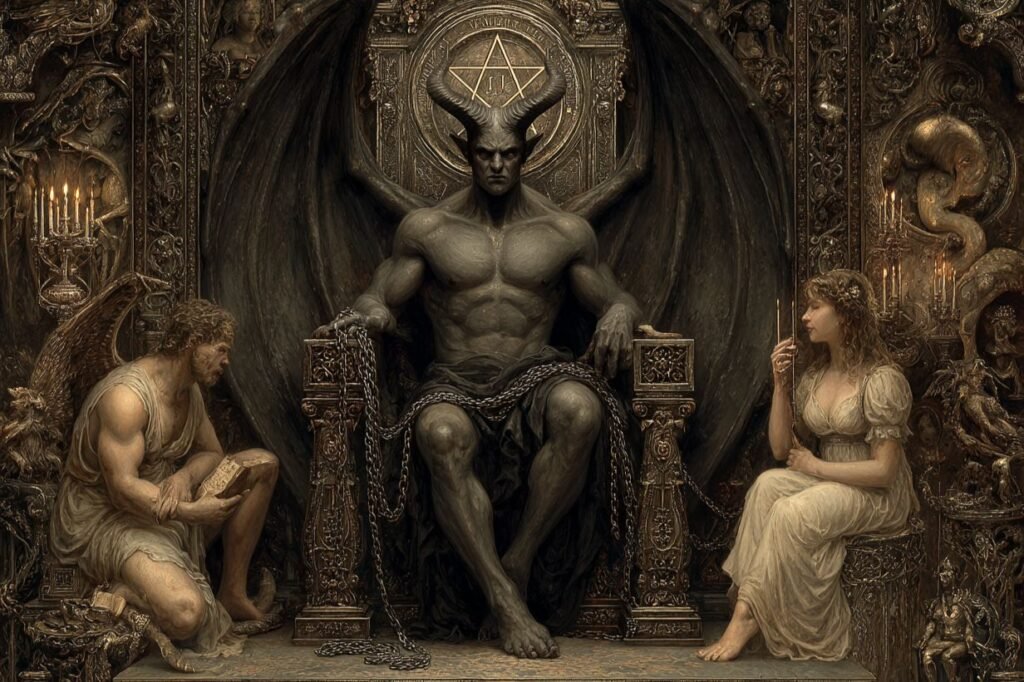
In the classic Rider-Waite image, two human figures stand chained at the base of a stone altar. A devil-like figure looms above them – part goat, part bat, part something archaic and unsettling. The inverted pentagram above its head represents the material dominating the spiritual, appetite overriding awareness. The torch it holds points downward, burning low, illuminating nothing useful.
But look at the chains around the figures’ necks.
They’re loose. Not locked tight. Not welded shut. Loose enough that either figure could, with a clear decision, lift them free and walk away. That detail is the entire card in miniature. The question isn’t can you leave – it’s why haven’t you?And more precisely: what are you telling yourself about why you can’t?
The two figures deliberately echo The Lovers card – the same pair, the same world. But here they’ve turned away from each other and toward the figure above them. They’ve reoriented their attention around the fixation. One figure’s tail ends in a flame, the other in grapes – desire, pleasure, the body’s insistent wants. These aren’t evil symbols. They’re human ones. The card isn’t condemning appetite. It’s asking what happens when appetite becomes the only thing you’re listening to.
The atmosphere of the card is dim. Underground. It carries the feeling of a basement at 3am – not exactly dangerous, but sealed off from air, from light, from the world that’s still moving without you. That world hasn’t disappeared. It’s just very easy, in this space, to forget it exists.
Upright Meaning
When The Devil appears upright, something in your life has tightened its grip on you – or you on it.
This might be visible and obvious: a substance, a toxic relationship, an obsessive thought pattern, debt that keeps growing. But it can also be far more subtle. An emotional dynamic in a family that everyone plays along with. A work environment that slowly extracts everything while promising security. A version of yourself you’ve been performing for so long that you’ve forgotten it’s a performance.
The upright Devil says: something owns a part of you right now. Not permanently. Not irreversibly. But for the moment, you’re operating inside its logic rather than your own.
Common real-life appearances:
- Staying in a relationship you know isn’t right because the pull is too strong, the chemistry too intense, or the fear of loneliness too loud
- A pattern of self-sabotage that shows up right before something good
- Using something – food, scrolling, work, substances, drama – to avoid feeling something else
- Feeling enslaved to money, status, or external validation
- A compulsive thought pattern you can’t seem to stop even when you recognize it
- Shame that keeps you silent about something that deserves to be named
Reversed Meaning
The Devil reversed is one of the most meaningful reversals in tarot – because it doesn’t just mean “less Devil energy.” It means the beginning of something.
It can signal the moment of recognition. The moment you look at the chain and actually see it. Not just feel it, but see it – and begin to understand how it got there, how you’ve been holding it, and what it would actually mean to set it down.
The Devil reversed meaning includes:
- Waking up inside a pattern you’ve been numb to
- The uncomfortable moment of choosing freedom over familiarity
- Breaking a habit, leaving a dynamic, stopping a cycle – even if it’s only the beginning
- The collapse of denial. Seeing clearly, perhaps for the first time in a while
- The discomfort that comes after the chains loosen – which is its own kind of challenge
- Realizing the thing you thought controlled you had far less power than you believed
The reversed card can also indicate a kind of false liberation – someone who thinks they’ve broken free but has simply replaced one attachment with another. Or someone on the edge of awakening who is turning back toward the familiar because freedom feels too exposed.
Liberation is rarely clean or linear. The Devil reversed honors the complexity of that process.
Love and Relationships
In love, The Devil tarot meaning is often about intensity mistaken for depth.
There’s a particular quality to relationships that fall under this card – they feel magnetic, consuming, almost impossible to imagine living without. The connection can feel more alive than anything else. And sometimes that’s real love finding its footing. But sometimes it’s a bond built on need, on fear, on the specific relief of being understood by someone who reflects your wound back to you – which can feel like being known, even when it isn’t the same thing.
The Devil in love can look like:
- Chemistry so strong it consistently overrides judgment
- Staying because leaving feels genuinely impossible, even when staying is clearly costly
- A power imbalance that has gradually become the emotional center of the relationship
- Dependency dressed as passion – the two can be almost indistinguishable from inside
- Returning to someone repeatedly, knowing the dynamic, knowing what will happen, returning anyway
- Silence maintained not from peace but from the knowledge that honesty might destabilize everything
- A bond held together less by what’s good between you and more by shared history, shared pain, or the sheer weight of familiarity
It also appears in subtler forms. The relationship where one person does all the emotional labor because saying so would rupture the dynamic. The connection maintained by obligation or guilt rather than genuine desire. The love that started real and has slowly become a habit neither person has examined recently.
The question this card asks in relationships is a tender one: Are you here because you want to be, or because you can’t picture how to leave?
Both can be true at once. The Devil doesn’t judge. It just holds the mirror steady.
Career, Money, and Work
In a career reading, The Devil tarot meaning often points to a deal that has become a trap – usually one that was entered freely, even eagerly.
The job that compensates extremely well and costs you your health, your creativity, your time, your sense of who you were before you became so good at performing this particular role. The industry you shaped your identity around that no longer reflects anything you actually value. The workplace culture that runs on pressure and fear, which you’ve learned to navigate so fluently that you’ve almost stopped registering it as a problem.
It also touches on ambition itself – when the drive for success, status, or security quietly takes over. When working long hours stops being commitment and becomes a way of not sitting with your own life. When you’ve organized your entire sense of worth around productivity and haven’t questioned that arrangement in years.
Financially, The Devil can appear as:
- Debt that expands because the spending is also emotional management
- Financial dependence on someone that quietly shapes what you’re willing to say, do, or ask for
- Staying in a draining situation because the alternative – uncertainty, starting over, earning less – feels worse than the known cost
- Using money as proof of something, earning it or spending it in ways that have more to do with fear or self-worth than with actual need
The pointed question this card raises in career: What would you do if the incentives changed? What would you walk away from? What have you been trading, and is it still a trade you’d consciously choose?
Spiritual Lesson
The Devil’s spiritual lesson isn’t “avoid darkness.” That would be too easy – and it would miss the point entirely.
The lesson is honesty. Specifically, the kind of honesty that requires looking at what we’d prefer not to see – the places we’ve been participating in our own limitation, the attachments we’ve been calling needs, the desires we feed quietly while publicly disowning them, the stories we’ve constructed that let us stay stuck while still feeling like the reasonable one.
The Devil asks you to name what owns you. Not to shame it. Not to perform willpower around it. Just to see it clearly – which is genuinely where any real change begins.
This card is connected to the shadow in the Jungian sense: the parts of yourself you haven’t integrated will find ways to run you from beneath the surface. The Devil makes that visible. When you can see it, you have a choice. Until you can, the pattern simply continues, and you experience it as fate.
The spiritual work here is the reclaiming of authorship. Noticing where you handed control over to a habit, a fear, a dynamic, a craving – and asking, honestly, whether that trade still makes sense now.
Energy of the Day
A Devil day often doesn’t announce itself dramatically.
It tends to arrive as a pull – toward something you know isn’t serving you, or a restlessness that wants to be resolved by the most familiar exit route. There may be a low-grade tension under the surface, an edge of craving, a heaviness that makes the easier escape feel like the only logical option.
It might also be a day when something becomes visible that you’ve been carefully managing not to see. A moment in a conversation that clarifies something you’ve been softening. A feeling that arrives and doesn’t go away when you distract yourself. A pattern that briefly, clearly, looks like exactly what it is.
On a Devil day: notice what’s pulling at you. You don’t have to resist everything. But notice what’s actually doing the choosing.
Advice
The advice of The Devil is not be stronger or just stop.
It’s more precise than that – and more useful.
Look at the structure of the loop, not just the feelings inside it. What triggers it. What it offers. What it costs. What it’s been protecting you from having to face. When you can see the architecture of a pattern clearly, you’re no longer entirely inside it. That gap – between the pull and the action – is where choice starts to become possible again.
Name what you’re actually attached to. Not what you think you should value, but what you genuinely can’t imagine releasing – or what you react to most sharply when it’s threatened. Attachment isn’t always visible in what we pursue. Sometimes it’s most visible in what we defend.
Ask yourself where fear is quietly making your decisions. Where shame is keeping you silent about something that deserves a voice. Where comfort or pleasure has become the primary reason you’re not moving. These aren’t moral failures. They’re just patterns. And patterns, once seen honestly, can be changed.
The chains in this card are loose. That’s not a consolation. That’s the point.
Why This Card Keeps Appearing
If The Devil keeps appearing in your readings, something is persisting – and it hasn’t yet been addressed where it actually lives.
This card doesn’t repeat to punish or alarm you. It repeats because the pattern it’s pointing to is still running. You may have managed it, contained it, temporarily stepped away from it – but not yet looked honestly at what sustains it, what function it serves, what you’d have to feel or face if it weren’t there.
Recurring appearances of this card often signal a truth that’s being circled rather than landed on. An attachment being quietly defended. A dynamic being described as smaller or less significant than it is. A habit being explained rather than examined.
Sometimes the card appears multiple times as awareness is building – as if the recognition is getting closer, gaining weight, moving toward the surface. And then, when the thing is finally seen and named, the card stops appearing. Not always immediately. But it stops.
If The Devil keeps finding you, sit with it – not with dread, but with the real question beneath all its symbolism: What are you still not quite ready to see? And what would it cost you, honestly, to see it?
Final Reflection
The most disturbing thing about The Devil isn’t the imagery.
It’s the moment of recognition. The moment you look at the card and think – quietly, without drama – yes. I know exactly what this is.
That recognition is where everything starts. Not the comfortable beginning, not the one that feels like progress – the real one. The kind that begins with seeing something clearly even when you’d rather soften it. The kind that asks you to be honest about where you’ve been trading your own freedom for something that felt, at some point, like it was worth the cost.
The figures in this card were never imprisoned.
They just wore the chains long enough to stop noticing the weight – until the weight became familiar, and familiar became necessary, and necessary became the story they told about who they were.
The chains were loose the whole time.
The only question The Devil ever asks is: when did you decide you couldn’t just lift them off?
Frequently asked questions
What does The Devil tarot card mean?
The Devil tarot card represents attachment, bondage, and unconscious patterns. It points to situations where desire, fear, habit, or shame is quietly running the show – keeping you in cycles that feel hard to break even when some part of you knows it’s time to change.
Is The Devil a bad tarot card?
Not in any simple sense. The Devil is a difficult card to face, but it isn’t a card of punishment or doom. It’s a mirror. It reflects the patterns, attachments, and self-deceptions we participate in – and in doing so, it opens the possibility of real awareness and genuine change.
What does The Devil mean in love?
In love, The Devil often points to intensity mistaken for depth – obsessive attachment, power imbalances, emotional dependency, or staying in a relationship because leaving feels impossible rather than because staying feels right. It can also reflect more subtle bonds held together by fear, habit, guilt, or shared dysfunction.
What does The Devil reversed mean?
The Devil reversed often signals a turning point – the moment of seeing a pattern clearly, beginning to break free, or realizing the chains were looser than they looked. It can mean waking up inside a cycle, the collapse of denial, or taking the first steps toward genuine liberation. It can also sometimes indicate a false or incomplete break, where one attachment has simply been swapped for another.
Why do I keep getting The Devil tarot card?
The Devil is usually pointing to something you already sense but haven’t fully named. It’s asking you to look honestly at where freedom is being traded for comfort, where fear or pleasure is making your decisions, and where something has more control over you than you’d prefer to admit. It’s not a warning about outside forces – it’s a conversation about what’s happening inside you.