The Fool doesn’t arrive when everything is ready.
It arrives at the edge – that specific, slightly vertiginous moment when you’ve run out of reasons to wait any longer. Not because the certainty has arrived. Because the waiting has become its own kind of trap, and some part of you has finally noticed.
What makes this card unsettling isn’t what it asks you to do. It’s what it asks you to release. The need to know in advance. The insistence on a guarantee before you move. The version of yourself you’ve spent years constructing – the one who has a plan, who has a reason, who can explain the decision to anyone who asks – left behind on the cliff edge, not because you’ve outgrown it, but because it can’t come where you’re going.
The Fool is not a card about recklessness. It is not a card about naïveté or chaos or throwing caution to the wind.
It is the card of the step that cannot be fully justified before it’s taken.
And most people – if they’re honest – know exactly what that feels like.
Quick Answer
The Fool tarot meaning centers on openness, trust, and the willingness to move forward before everything is figured out. This is the card of beginnings that don’t yet have a shape – of stepping into something without the protection of certainty or the security of a fully formed plan.
The Fool tarot card represents the psychological state of genuine openness: the moment before identity hardens, before experience narrows the field, before you know enough to be afraid of what you don’t know. It is not about being unprepared. It is about being willing to begin anyway.
The Fool is not the card of ignorance. It is the card of trust – the specific, demanding kind that exists before proof.
Key Takeaways
- The Fool tarot meaning is movement before certainty – the step taken before everything is understood.
- It is not recklessness. It is trust without a guarantee, which is harder than it sounds.
- The Fool marks the moment before identity solidifies – you are not yet defined by what comes next.
- Upright: a genuine beginning is available right now. Reversed: fear dressed as caution, or freedom used as escape.
- The gap between readiness and willingness is not small. The Fool lives in it.
- Waiting until you’re certain is sometimes wisdom. Often it is just the long way around fear.
- The Fool doesn’t arrive when the path is clear. It arrives when standing still has become the more expensive option.
What Does The Fool Tarot Card Mean?
The Fool tarot card means something is asking to be begun – before you feel ready, before the plan is complete, before the outcome is guaranteed.
This card appears when the moment of genuine openness has arrived – when the usual protective mechanisms of planning, preparing, and waiting for clarity have reached the limit of what they can provide. It points to a step that is available right now, if you’re willing to take it without the protection of certainty.
It is the card of the person who is about to become something they haven’t been yet.
Core Meaning
The Fool tarot card represents the state of psychological openness that exists at the beginning of any real journey – before experience has narrowed the possibilities, before identity has calcified around a particular set of habits, roles, and self-definitions.
The Fool is numbered zero in the major arcana – not one, not first. Zero: the space before counting begins. The state before definition. This is deliberate. The Fool is not the start of something specific. It is the condition of possibility itself – the open field before any particular path is chosen and the others are left behind.
That openness is both the gift of this card and its challenge. To be genuinely open to what comes next means releasing the grip on what was. It means moving without the armor of a prepared identity. And that is harder, for most people, than any specific difficulty the journey might contain.
Deeper Meaning
Here’s what doesn’t get said often enough about The Fool: the thing it’s asking you to trust is not the outcome.
In tarot, The Fool is often read as the lightest card in the deck – the carefree beginning, the open road. But that reading misses the weight of what it actually asks. Most people, when they imagine stepping into the unknown, imagine trusting that it will work out. That the leap will have a landing. That the new thing will be good. But that’s not quite what The Fool describes. The Fool is the step before you know whether it will work — and more than that, before you can know. The trust it requires is not trust in a specific result. It is trust in the act of moving itself.
The Fool doesn’t ask you to believe everything will be fine. It asks you to move anyway.
This is why the card is psychologically demanding in a way that doesn’t always get acknowledged. Humans are deeply oriented toward certainty. The mind wants a map before the journey, a guarantee before the risk, a reason that holds up under scrutiny before the action. And often, the preparation that looks like wisdom is actually a way of managing the fear of not knowing. Another round of planning. Another reason to wait. Another thing to figure out first – until waiting has quietly become the default, and the thing you were preparing for has started to feel theoretical.
The Fool arrives at that point. Not to push you recklessly over the edge, but to ask honestly: Is this caution, or is this avoidance?
Worth noting: The Fool’s openness is not immunity from disruption. When genuine movement enters something unstable – a situation, a relationship, a direction that isn’t what it appeared to be – The Tower may be what follows. The Fool doesn’t walk into every unknown safely. It walks in willingly.
There’s also something The Fool touches that goes deeper than decision-making: identity. The step it represents is not just a new action. It is a movement away from a previous self-definition. And that is where the real difficulty lives – not in the unknown in front, but in the known behind. The role you’ve been playing, the story you’ve been telling about who you are and what you do, the version of yourself that feels solid and real precisely because it’s been held for so long. The Fool asks you to leave that at the edge and walk forward as someone not yet fully formed.
Freedom is not the absence of identity. It is the willingness to hold it loosely.
Most people are considerably more attached to their self-concept than to their actual circumstances. They can change jobs, cities, relationships – and stay fundamentally the same person inside the same story. The Fool is not that. The Fool is the moment the story itself becomes open.
What comes after The Fool is shaped by what you carry with you. The art is in knowing what to leave behind.
What The Fool opens, The Magician directs. The first card is the willingness to begin – the second is the skill and intention that give the beginning its shape. One without the other tends to produce either paralysis or drift.
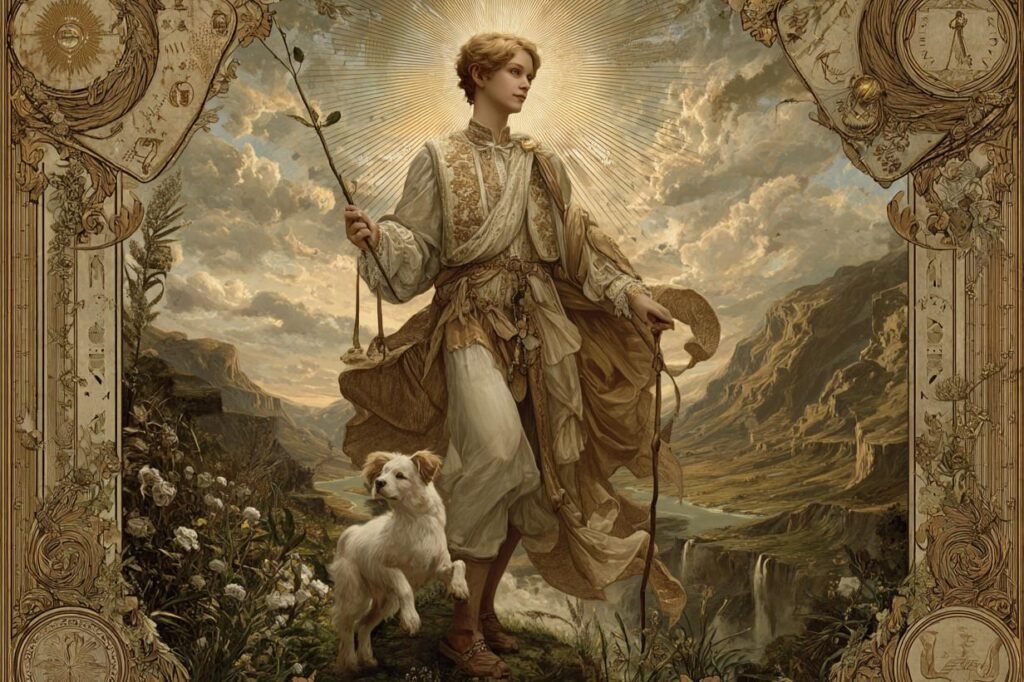
The Rider-Waite image of The Fool is deceptively simple – and every element of it is more specific than it first appears.
A young figure stands at the edge of a cliff, face tilted upward, one foot already beyond the solid ground. He carries a small bag on a stick over his shoulder. A white dog is at his heels. In his hand, a white flower. Behind him, the sun rises – or shines – at full brightness. The mountains in the background are distant, cool, and unmoved.
The cliff is the most obvious symbol and the easiest to misread. It looks like danger. But look more carefully at what the figure is doing: he is not looking at the cliff. He is not looking at the drop. He is looking upward – at the sky, at what is ahead, not at the risk beneath his feet. This is not stupidity. It is the specific orientation of someone who has made the decision and is no longer rehearsing the doubt. The risk is real. His attention is elsewhere.
The small bag is the card’s most practical symbol: the past has been distilled down to what can actually be carried. Not left behind entirely – the figure has his history, his skills, his experience. But it has been compressed. Edited. Reduced to what is genuinely necessary. The Fool doesn’t travel without context. He travels light.
The white dog at his heels is almost universally read as instinct – the part of you that is aware of the danger, that has registered the edge, that would perhaps urge caution. And yet the dog is not stopping him. It is present, attentive, and following. This is not recklessness overriding instinct. It is instinct choosing to come along.
The white flower in his hand is not decoration. It is openness – innocence in the real sense, not naïveté. The quality of meeting what comes without the filter of excessive preconception. He is not walking toward the unknown armored with conclusions about what it will be.
And the sun behind him: full, bright, and not yet directly in his line of sight. The clarity is there. It will be useful. But the journey begins before it’s fully in view.
Upright Meaning
When The Fool appears upright, something is asking to be begun – and the card is asking whether you’re willing to begin it before the usual conditions of readiness are met.
This is not a card that asks you to abandon discernment. It asks you to notice when discernment has become a tool for staying still rather than for navigating genuine movement. When the next round of planning is actually the next round of postponement. When waiting for clarity has become a way of never having to find out.
The upright Fool describes someone at the threshold of a genuine beginning – not the kind that requires no courage, but the kind that requires the specific courage of moving without a guarantee.
Common real-life appearances:
- Leaving a job, a city, a relationship, or a version of your life before the next thing is fully secured
- Starting something – a creative work, a business, a project – without the full plan, because the full plan keeps not arriving
- Saying yes to something before you’ve finished talking yourself out of it
- Trusting a new connection before you have enough evidence to be certain about it
- Choosing to try something that might not work, because not trying it has stopped feeling like safety
- The specific sensation of having made the decision and feeling, simultaneously, terrified and more alive than you have in a while
→ Upright, The Fool means the moment of genuine beginning is available – and the only thing missing is the willingness to take it without the usual protection.
Reversed Meaning
The Fool reversed does not mean the same card with less energy. It means a specific distortion of what the card describes – and there are two distinct versions worth understanding.
The first is fear masquerading as wisdom. This is the version where caution has become chronic. Where the planning continues past the point of usefulness. Where every step toward beginning generates a new reason to wait – and those reasons always seem legitimate, always seem responsible, always seem like wisdom that the other version of you would have missed. But the journey doesn’t start. The beginning doesn’t arrive. And at some point the careful, considered not-doing starts to cost as much as any leap ever would have.
The Fool reversed meaning in this direction includes:
- Overthinking a decision that has already been made on some level
- Waiting for a certainty that is not actually available – not because the situation is unclear, but because certainty isn’t how beginnings work
- Mistaking anxiety for good judgment
- Staying in something known and no longer right because the unknown feels worse
- Consistently finding reasons that this isn’t the right moment, while the moments keep passing
The second direction is the opposite distortion: recklessness that mistakes itself for The Fool’s energy. True openness is not the same as abandoning awareness. The Fool carries a small bag – he has not abandoned everything, discarded all preparation, or decided that consequences don’t apply to him. The reversed card can point to someone using “freedom” or “spontaneity” as cover for not wanting to be accountable for choices.
This version shows up as:
- Impulsive action that skips over genuine reflection and later claims it was trust
- Beginning things without any real commitment – collecting starts without follow-through
- Using the language of openness and freedom to avoid the work that real beginnings require
- A pattern of leaving before things get difficult and calling it a sign
→ Reversed, The Fool describes either the step not taken or the step taken without the awareness that makes it real.
Real-Life Reflection
The Fool tends to arrive in readings at a very specific kind of moment – one most people recognize immediately when it’s named.
It is not the moment of crisis. Crisis has a clarity of its own; it removes options. This is the moment of choice, which is harder. When things are stable enough to stay but not good enough to justify staying. When the direction you want to move in is visible but the path isn’t clear. When you’ve run out of reasons to wait and haven’t yet summoned the willingness to begin.
The most common version looks like this: the planning has gone on long enough that the plan has become the thing. The research, the preparation, the conditions that need to be in place before you start – they’ve expanded to fill all available space. And they feel like progress. They look like responsibility. From the inside, they feel like patience.
But the beginning keeps not happening.
The Fool arrives at exactly this point – not to push you forward recklessly, but to ask what, specifically, would have to be true before you’d feel ready. And then to sit quietly while you realize the answer is something that is not actually available in advance.
The other version is subtler: the person who keeps beginning and not continuing. Who moves from start to start, from possibility to possibility, because the energy of openness is genuinely pleasurable and the demands of an established thing are less so. The Fool recognizes this too – and points gently at the difference between genuine openness and the preference for potential over reality.
Love and Relationships
In love, The Fool tarot meaning describes the specific quality – rare and recognizable – of entering a connection without the usual protective architecture.
Most people bring considerable structure to new relationships: expectations shaped by what has happened before, ways of reading behavior based on patterns that may or may not apply here, protective mechanisms that developed after previous losses. This is not wrong. It’s how people avoid repeating what cost them. But it also means that what’s actually in front of them is sometimes harder to see than the template they’re projecting onto it.
The Fool in love is the moment when that architecture is light enough that genuine contact is possible. When someone is met as they actually are rather than as a version of someone who came before. When the connection is allowed to be what it is rather than what it is supposed to be.
This can look like:
- A new relationship beginning with unusual ease and genuine curiosity
- Allowing yourself to be vulnerable before you’ve confirmed it’s safe – which is the only way vulnerability is ever actually possible
- Meeting someone in a moment of your own genuine openness and finding the connection has a quality that protected versions of yourself don’t produce
- The willingness to be in something new without immediately needing to know where it’s going
But The Fool in love also has its shadow. The same openness that makes genuine connection possible can mean patterns are missed. Not because the signs weren’t there but because the Fool orientation – trusting, present, not yet armored – doesn’t always register what experience would catch. The card doesn’t caution against this. It acknowledges it. Love entered with genuine openness carries that risk. It also carries something protected love rarely does.
The question The Fool asks in relationships: Are you meeting this person – or the idea you already have of them?
Career, Money, and Work
In career readings, The Fool tarot meaning points to the beginning of something that hasn’t yet found its form – and to the specific decision of whether to commit to it before the form arrives.
This might mean leaving a stable position before the next one is secured – because staying has stopped being sustainable and the only real choice is the one that requires trusting the trajectory rather than the destination. It might mean starting something new with fewer resources, less preparation, or less certainty than feels comfortable. Or it might simply mean taking an action – making the call, submitting the application, beginning the project – that cannot be fully justified in advance.
The meaning of The Fool tarot card in work is not about impulsive leaps without thought. It is about recognizing when thought has completed its useful work and the only remaining step is the one that thinking cannot provide.
Career appearances:
- Starting a business, project, or creative work before the conditions feel fully right – because they will not feel fully right before you start
- Leaving a role that no longer fits, even before the next thing is clear
- Saying yes to an opportunity that stretches beyond your current self-definition
- A career change that requires identifying as something you don’t yet have evidence of being
- The specific experience of doing something for the first time – with all the awkwardness and aliveness that contains
Financially, The Fool asks for a quality of trust that financial thinking tends to resist: the willingness to invest – time, money, energy – in something whose return cannot yet be confirmed. Not recklessly. But without the guarantee that would make the investment feel safe.
Spiritual Lesson
The spiritual lesson of The Fool is one of the most quietly radical in the entire major arcana: trust is not certainty, and it was never supposed to be.
The need for certainty before movement is understandable. It feels like wisdom, feels like responsibility, feels like taking life seriously. But certainty, in the domain of genuine beginning, is almost never actually available. What’s available is enough information to make a considered choice – and then the step itself, taken with what is known and what is not.
The Fool’s lesson is that this is sufficient. Not comfortable, not without risk, not without the possibility of being wrong – but sufficient. The step can be taken from here. From this level of knowing, this level of clarity, this level of readiness. The journey will provide what preparation cannot.
You do not need to be ready. You need to be willing.
There is also something The Fool teaches about identity – about the cost of holding a self-concept too tightly. The versions of ourselves we’ve built are real. They are constructed from genuine experience, genuine learning, genuine survival. But they are constructions. And they can reach a point where they are protecting us from the very experiences that would allow us to grow past what they contain.
The spiritual invitation here is not to abandon yourself. It is to hold yourself lightly enough that you can become more than you currently are.
The Fool steps off the cliff. What lands is not the same as what jumped.
This is what Judgment – the card of self-realization that waits further along the major arcana – eventually names: the awakened awareness that only becomes available after genuine experience. The Fool makes that experience possible by being willing to enter it.
Energy of the Day
A Fool day doesn’t feel certain – it feels possible.
That distinction is worth paying attention to. It is not the confidence of knowing what happens next. It is the specific openness of a day where the usual arguments for staying still have loosened their grip, and something – not yet named – is pulling in a direction.
There may be an impulse toward something new – a conversation you wouldn’t normally initiate, a direction you find yourself curious about, a decision that keeps surfacing. The mind may be more open than usual, less attached to the established routes. Things feel slightly less fixed.
There may be an impulse toward something new – a conversation you wouldn’t normally initiate, a direction you find yourself curious about, a decision that keeps surfacing. The mind may be more open than usual, less attached to the established routes. Things feel slightly less fixed. The usual arguments for staying still seem slightly less compelling.
On a Fool day: pay attention to what’s pulling at you before the usual analysis begins. Not because the analysis isn’t useful, but because the first movement of genuine impulse carries information that the subsequent thinking often buries. Note what arrives before you talk yourself into or out of it.
This is not a day to be reckless. It is a day to be honest about what you want to begin – and to notice whether the reasons you’re not beginning it are real or habitual.
Advice
The Fool’s advice is precise, and like everything about this card, more demanding than it first appears.
Move before everything is figured out. Not carelessly – but before the conditions of full readiness are met, because they will not be met before you begin. The clarity you’re waiting for is not going to arrive in advance. It arrives in the process. Starting is what makes it available.
The readiness you’re waiting for is on the other side of the step, not before it.
Distinguish between fear and intuition. Both can tell you not to begin. Fear sounds like: the conditions aren’t right, the timing is wrong, you need more preparation, it might not work. Intuition sounds different – quieter, less verbal, more physical. A practical way to tell them apart: fear tends to be verbose and consistent; intuition tends to say the same thing briefly, and then go quiet.
Notice what you’re actually waiting for. Not in the abstract – specifically. Write it down if you need to. What exact condition would have to be met before you’d feel ready to begin? And then ask honestly: is that condition actually coming? Or is it the kind of requirement that generates itself indefinitely?
Notice what you’re carrying. The Fool travels light – not because he has no past, but because he’s edited it down to what’s genuinely necessary. Look honestly at what you’re bringing into the new thing. What of it is actually useful – and what is just familiar enough to feel necessary?
Begin. Adjust as you go. That is all the Fool has ever asked.
Why This Card Keeps Appearing
If The Fool keeps appearing in your readings, something is consistently waiting to be begun – and the beginning keeps being deferred.
This card recurs when the threshold has been reached repeatedly without being crossed. When the planning has gone on past the point of its own usefulness. When the argument for waiting has been running long enough that it has started to feel like the decision itself, rather than the thing that precedes it.
It can also recur when the openness the card describes is being avoided in a more specific way: when identity has calcified around a particular role, story, or self-concept, and the movement forward would require releasing some of that – which is genuinely difficult, genuinely uncomfortable, and worth doing.
The Fool keeps appearing because the step it’s pointing to keeps not being taken.
Sometimes it appears repeatedly when someone is very close – when the decision has effectively already been made somewhere beneath the surface, and the reading keeps reflecting what the conscious mind keeps finding reasons to delay. The card is not pointing at a distant possibility. It is pointing at the next step. The one that is available, specifically, now.
If this card keeps finding you, the useful question is not what it means. It means what it always means. The useful question is: what, specifically, are you still waiting for – and is that thing actually coming, or are you waiting for something that will not arrive before you begin?
Final Reflection
There is a version of safety that looks like wisdom.
It is the safety of the fully formed plan, the secured outcome, the position that can be explained and justified and defended. It is the version of yourself that doesn’t make moves that might not work out. That doesn’t begin things whose endings are unknown. That doesn’t step into spaces where the old self-definition doesn’t quite apply.
This version is not wrong. It has kept you intact through things that required exactly that kind of protection.
But The Fool points to something it cannot provide: the specific aliveness of the step taken before the guarantee. The quality of experience that only exists in genuine openness – before the outcome is known, before the identity has reorganized around the new thing, before the unknown has been made familiar.
The figure on the card is about to step off the cliff. He does not know exactly what happens next.
But the sun is rising behind him. The bag is light. The dog is with him. And the flower in his hand is still white – held by someone who has not yet been changed by what’s coming.
Whatever comes next will change him. Whatever comes next will narrow the field, make some things real and close others, produce experience that cannot be unfelt.
But not yet.
Right now he is still at the edge. Still open. Still possible.
The step itself is where everything begins. Not before it. Not after it. In it.
You don’t become ready. You become someone who moved – and found that moving was enough.
Frequently asked questions about the Fool tarot card
What does The Fool tarot card mean?
The Fool tarot card represents openness, trust, and the willingness to begin before everything is certain. It appears when a genuine new beginning is available – one that requires moving forward without a guarantee, before the conditions of full readiness are met. It is not a card of recklessness. It is a card of existential trust.
Is The Fool a good or bad card?
The Fool is one of the most affirming cards in tarot, but it asks something specific of the person drawing it. It is not unconditionally positive – its energy is only useful if it is engaged with honestly. Upright, it points to a genuine beginning available right now. Reversed, it can indicate fear disguised as caution, or freedom misused as avoidance.
What does The Fool mean in love?
The Fool tarot meaning in love describes the quality of entering a connection without the usual protective architecture – with genuine curiosity, genuine openness, and the willingness to be present before you know how it ends. It can point to a new relationship beginning with unusual authenticity, or to the invitation to meet someone as they actually are rather than as a version of someone who came before.
What does The Fool reversed mean?
The Fool reversed meaning points to one of two distortions: fear that has been mistaken for wisdom – chronic planning, permanent preparation, the perpetual not-quite-right moment for beginning – or recklessness that mistakes itself for genuine openness, using “freedom” as cover for avoiding accountability. In both cases, the real beginning is being missed.
Why do I keep getting The Fool?
If The Fool keeps appearing, a beginning keeps being deferred – and the deferral has gone on long enough to be its own kind of pattern. The card recurs when the threshold of genuine movement is being approached repeatedly without being crossed, when the planning has extended past the point of useful preparation, or when an identity or story is being held so tightly that the movement forward would require releasing something that feels necessary.
What is The Fool trying to tell me?
The Fool is usually pointing to a step that is available right now – and asking what is making you wait. Not to push you into recklessness, but to ask honestly whether the caution is serving genuine discernment or has become a way of never having to find out. The card is not asking you to abandon awareness. It is asking you to move, with everything you have, before everything is secured.
Want to understand Tarot on a deeper level?